Even if you are mathematically challenged, you still might enjoy David Stephenson's June 2005 article from Physics Today - Tsunamis and Earthquakes: What Physics is Interesting?
He explains the dynamics involved in earthquakes and tsunamis. He also explains why the tsunami is better understood than the earthquake itself.
It's great to read an physics article so clearly written that I can share it with my friends who lack a scientific knowledge. People want to learn more right now about these natural events and what causes them.
10 June 2005


Quick Guide to Human Capital Management Ratings
Denis Barnard sent me an article to read about Human Capital Management. This immediately caught my eye - "The ‘Newbury Index Rating’ (NIR) for human capital value, which is based on a similar system to Standard & Poor’s credit ratings, is the first universal framework for measuring the value of staff, according to its developers."
It wasn't until I read Denis' email again that I realized this was his team who had established a standard for measuring human capital. Working in collaboration, Denis Barnard, Paul Kearns and Tracy Cartland-Ward have put together a rating system that indicates how well an organization is capitalizing on the value of its people.
In their A Quick Guide to Human Capital Management Ratings, you will find a clear explanation of The Newbury Index Ratings (NIR’s). You will also find its distinguishing strategic value in the comparison between HCM and traditional HRM (Human Resource Management).
Now I would like to follow the companies that adopt this rating system and see how they use it to strategic advantage. Again, we face the BIG questions inside organizations "Are we building markets or communities?" and "Is our organizational performance tied more to capturing the value of unique personal performance than product performance?"
It wasn't until I read Denis' email again that I realized this was his team who had established a standard for measuring human capital. Working in collaboration, Denis Barnard, Paul Kearns and Tracy Cartland-Ward have put together a rating system that indicates how well an organization is capitalizing on the value of its people.
In their A Quick Guide to Human Capital Management Ratings, you will find a clear explanation of The Newbury Index Ratings (NIR’s). You will also find its distinguishing strategic value in the comparison between HCM and traditional HRM (Human Resource Management).
Now I would like to follow the companies that adopt this rating system and see how they use it to strategic advantage. Again, we face the BIG questions inside organizations "Are we building markets or communities?" and "Is our organizational performance tied more to capturing the value of unique personal performance than product performance?"
9 June 2005
Brand Wikification
Nick Wreden has opened up a pertinent discussion with his blog on FusionBrand: How To Wikify Your Brand.
In his blog, he reflects on the changing midset of the NewBoardRoom mentality. For decades, the focus has been on growing market share through product positioning, a practice that leveraged mass markets and mass media. Now, the internet paradigm is fragmenting those mass markets into masses of small communities. This is throwning the balance of power back into the hands of the customers. Brands are now defined by their customers, and those customers want to participate in how they want to experience the brand.
Wikification - taking its name from wikis - according to Nick "represents good news and even better news for marketers. The good news is that it incorporates two elements that no boardroom can ignore – measurement and knowledge of what customers value. The even better news is that wikification forces everyone in marketing to value metrics more than “mind share,” “creativity” or any other eye-of-the-beholder concept. It also leads to greater marketing involvement in databases and operational issues that deliver customer value."
It will be interesting to track where these perspectives begin to show up at Board Room altitude. Wikis, blogs, and all this dynamic network behavior is certaining shaping our relationships with brands. Whether the corporate organizations managing them can evolve their business models quickly enough to capture the value of this new behavior is something we're all watching and waiting to see.
Anyway, I really like this term he has coined -
wikification. Keep your eyes open and please share anything you notice along these lines.
In his blog, he reflects on the changing midset of the NewBoardRoom mentality. For decades, the focus has been on growing market share through product positioning, a practice that leveraged mass markets and mass media. Now, the internet paradigm is fragmenting those mass markets into masses of small communities. This is throwning the balance of power back into the hands of the customers. Brands are now defined by their customers, and those customers want to participate in how they want to experience the brand.
Wikification - taking its name from wikis - according to Nick "represents good news and even better news for marketers. The good news is that it incorporates two elements that no boardroom can ignore – measurement and knowledge of what customers value. The even better news is that wikification forces everyone in marketing to value metrics more than “mind share,” “creativity” or any other eye-of-the-beholder concept. It also leads to greater marketing involvement in databases and operational issues that deliver customer value."
It will be interesting to track where these perspectives begin to show up at Board Room altitude. Wikis, blogs, and all this dynamic network behavior is certaining shaping our relationships with brands. Whether the corporate organizations managing them can evolve their business models quickly enough to capture the value of this new behavior is something we're all watching and waiting to see.
Anyway, I really like this term he has coined -
wikification. Keep your eyes open and please share anything you notice along these lines.
Reboot 7.0 in Copenhagen this weekend
Just spoke with Ton Zijlstra. He and Elmine Wijnia are driving up to Reboot 7.0 in Copenhagen this weekend.

They'll join the other bloggeratti in exploring the impact of social media and its tools on our many worlds. We're looking forward to hearing about their adventure next week.
Among the cast - Jonnie Moore, Doc Searls, Robert Scoble, Jimbo Wales Cory Doctorow, David Weinberger, Loic Le Meur, Dina Mehta
They'll join the other bloggeratti in exploring the impact of social media and its tools on our many worlds. We're looking forward to hearing about their adventure next week.
Among the cast - Jonnie Moore, Doc Searls, Robert Scoble, Jimbo Wales Cory Doctorow, David Weinberger, Loic Le Meur, Dina Mehta
Information Overload & Strategies for This
We're living in a time when we are inundated by media throughout most of our waking hours. We grapple with getting our minds to regular points of rest and focus.
Then we sit in front of our computers and stare at the files and think "Now, where did I file that great quote?", or "Which files have that info about this subject?"
What we need to do is develop personal information management strategies - PIMS. We each need a strategy that guides how we organize and file and store information so that we can access it and assemble it in our own way of thinking and working. This needs to be based on how we think, how we want to use that information, how we apply information, - and ultimately how we package that information into knowledge concepts. It's important to address issues like no online access when you spend hours on trains or planes.
Ton Zilstra uses a wiki offline that he can sync online. Great way to package your thoughts and a way to capture the bits of info that fall into those threads of thinking that you just haven't built into anything yet. A constructive path. I'm going to explore this with him because he seems to be a whiz at this.
Then we sit in front of our computers and stare at the files and think "Now, where did I file that great quote?", or "Which files have that info about this subject?"
What we need to do is develop personal information management strategies - PIMS. We each need a strategy that guides how we organize and file and store information so that we can access it and assemble it in our own way of thinking and working. This needs to be based on how we think, how we want to use that information, how we apply information, - and ultimately how we package that information into knowledge concepts. It's important to address issues like no online access when you spend hours on trains or planes.
Ton Zilstra uses a wiki offline that he can sync online. Great way to package your thoughts and a way to capture the bits of info that fall into those threads of thinking that you just haven't built into anything yet. A constructive path. I'm going to explore this with him because he seems to be a whiz at this.
7 June 2005
Societies Shaped by their Media
Marshall McLuhan (1911 - 1980) claimed that societies were shaped by their media. The book was the organizing factor in one era. And, let's not forget the impact of the TV.
Today, the IDEA - or brand concept - is an organizing principle. Media today is about sharing ideas. Sharing ideas is shaping our world and evolving the economic business model.
Thomas Samuel Kahn (1922 - 1996) claimed that intellectual revolutions bring on paradigm shifts, replacing entire conceptual networks through which we view the world.
What happens when we look at social media as the organizing principle for a paradigm shift? What do you see then as the distinctive signs of this new culture?
Could INTERNET be the definitive paradigm for shaping our current culture and that of the future?
Today, the IDEA - or brand concept - is an organizing principle. Media today is about sharing ideas. Sharing ideas is shaping our world and evolving the economic business model.
Thomas Samuel Kahn (1922 - 1996) claimed that intellectual revolutions bring on paradigm shifts, replacing entire conceptual networks through which we view the world.
What happens when we look at social media as the organizing principle for a paradigm shift? What do you see then as the distinctive signs of this new culture?
Could INTERNET be the definitive paradigm for shaping our current culture and that of the future?
4 June 2005
Vanenburg Forum on Collaboration & Learning
This past Wednesday, I attended a forum on collaboration and learning at the newly opened Kasteel de Vanenburg in Putten in The Netherlands. This effort was effectively put together by Crossing Signals and The Global Learning Group - and was graciously hosted by Cordys.

We were there to share knowledge and insights about the issues we face in finding the right platforms that address learning, managing and sharing knowledge, and interactive communication. This was the first in a series of forums to discover the right keys to support an integrated platform that would wholely support social connectivity, learning, project management, and co-creative collaboration. Understanding how people engage and finding the right interface complete with built-in tools will be key. Tall order…we’ll see what transpires in the months ahead.
The pictures tell the story of that day much better than I can. The discussion is now activated and we’re looking forward to the feedback, which should find its place on a new blog that will be forthcoming and hosted by Rudy Hoeboer from Crossing Signals.
We were there to share knowledge and insights about the issues we face in finding the right platforms that address learning, managing and sharing knowledge, and interactive communication. This was the first in a series of forums to discover the right keys to support an integrated platform that would wholely support social connectivity, learning, project management, and co-creative collaboration. Understanding how people engage and finding the right interface complete with built-in tools will be key. Tall order…we’ll see what transpires in the months ahead.
The pictures tell the story of that day much better than I can. The discussion is now activated and we’re looking forward to the feedback, which should find its place on a new blog that will be forthcoming and hosted by Rudy Hoeboer from Crossing Signals.
31 May 2005
Metcalfe's Law overshoots the mark
Early in March, the New York Times published an article - Researchers: Metcalfe's Law overshoots the mark - about a paper written by 2 researchers refuting Metcalfe's Law, which is quoted as the rule of thumb for computing the value of communication networks. I recently read their academic paper again because of some work I am preparing for a client and a conference.
Andrew Odlyzko and Benjamin Tilly - researchers from the Digital Technology Center at the University of Minnesota - posit several arguments to substantiate that this rule is a "significant overestimate". Their paper - "A refutation of Metcalfe's Law and a better estimate for the value of networks and network interconnections" - explains why network growth rate is much slower than Metcalfe thought. And...why the dot-com and telecom boom failed.
They reviewed several quantitative models of networks...some dating back to 1974...and compared them to each other. Metcalfe's Law seemed to have an intuitive appeal, and people used it generously to project growth calculations for networks and to demonstrate "a linear relationship between the perceived size and value of a network".
I always wonder why business people grab onto "rules" like this without understanding their foundation, and without understanding the consequences of adopting it into practice. The sheer number of consultants and sales people using a "rule" like this and quoting it can turn it into a standard of practice, which is exactly what happened. This is what I call a borrowed strategy.
Perhaps it time to rethink our business models and make them unique to our businesses...and not borrow them from somewhere else.
Andrew Odlyzko and Benjamin Tilly - researchers from the Digital Technology Center at the University of Minnesota - posit several arguments to substantiate that this rule is a "significant overestimate". Their paper - "A refutation of Metcalfe's Law and a better estimate for the value of networks and network interconnections" - explains why network growth rate is much slower than Metcalfe thought. And...why the dot-com and telecom boom failed.
They reviewed several quantitative models of networks...some dating back to 1974...and compared them to each other. Metcalfe's Law seemed to have an intuitive appeal, and people used it generously to project growth calculations for networks and to demonstrate "a linear relationship between the perceived size and value of a network".
I always wonder why business people grab onto "rules" like this without understanding their foundation, and without understanding the consequences of adopting it into practice. The sheer number of consultants and sales people using a "rule" like this and quoting it can turn it into a standard of practice, which is exactly what happened. This is what I call a borrowed strategy.
Perhaps it time to rethink our business models and make them unique to our businesses...and not borrow them from somewhere else.
30 May 2005
Portugal to get world's first commercial wave farm
This news article from Reuters caught my attention because I used to live in Portugal, and the name of my company years ago was Waves. As I read further, I realized this is quite an innovative solution, making use of nature's water power.
The Scottish company Ocean Power Delivery (OPD) is going to build a wave farm off the coast north of Oporto near the town of Povoa de Varzim - a charming seaside place that's like stepping back into time. These underwater, long, sausage-like tubes will generate 2.25 megawatts of power for the renewable energy group Enersis. OPD is backed by Norwegian Norsk Hydro.
Not only does this effort save people from carbon dioxide emissions, it saves the planet from global warming. I just wonder what the impact is on the local eco-sealife?
The Scottish company Ocean Power Delivery (OPD) is going to build a wave farm off the coast north of Oporto near the town of Povoa de Varzim - a charming seaside place that's like stepping back into time. These underwater, long, sausage-like tubes will generate 2.25 megawatts of power for the renewable energy group Enersis. OPD is backed by Norwegian Norsk Hydro.
Not only does this effort save people from carbon dioxide emissions, it saves the planet from global warming. I just wonder what the impact is on the local eco-sealife?
National Geographic Sustainable Destinations Resource Center
These initiatives touch me, particularly when National Geographic puts their weight behind something this important - National Geographic Sustainable Destinations Resource Center.

"We want to help residents, visitors, and professionals practice what is now being called geotourism: tourism that supports the geographical character of the place being visited—its environment, culture, heritage, aesthetics, and the well-being of its citizens.
Awareness is the key. Residents who benefit from tourism tend to value and conserve what tourists are coming to see. Visitors reinforce that link when they support businesses that sustain the destination. We hope these web pages help, and we welcome your comments and suggestions."
Jonathan B. Tourtellot, Director of Sustainable Destinations
"We want to help residents, visitors, and professionals practice what is now being called geotourism: tourism that supports the geographical character of the place being visited—its environment, culture, heritage, aesthetics, and the well-being of its citizens.
Awareness is the key. Residents who benefit from tourism tend to value and conserve what tourists are coming to see. Visitors reinforce that link when they support businesses that sustain the destination. We hope these web pages help, and we welcome your comments and suggestions."
Jonathan B. Tourtellot, Director of Sustainable Destinations
The Dutch DARE - Digital Academic REpositories
Innovation does exist in The Netherlands! Take a look at what Dutch academics have collectively and effectively created by agreeing to open source their papers and share their knowledge - DAREnet. Digital Academic REpositories (DARE) has archived over 40,000 papers from 16 universities and made them available to the public. This is a permanent storage, which leaves a legacy of knowledge for future generations.

Just click on a name from the list of institutions and you link directly to their depot. Of course, this a project in-the-works -- and much of it is in the Dutch language or still under publisher's copyright. Still, what a step forward for a country that likes to charge you for every little step you take. This is also a relief for many academics and students who can no longer afford the expensive academic and scientific journals.
Check out Cream of Science, which lists 25,000 publications from over 200 Dutch scientists and researchers.
Go Open Source! Yea!
Just click on a name from the list of institutions and you link directly to their depot. Of course, this a project in-the-works -- and much of it is in the Dutch language or still under publisher's copyright. Still, what a step forward for a country that likes to charge you for every little step you take. This is also a relief for many academics and students who can no longer afford the expensive academic and scientific journals.
Check out Cream of Science, which lists 25,000 publications from over 200 Dutch scientists and researchers.
Go Open Source! Yea!
Last supper with my students
Friday, the students from my course at the University of Amsterdam Graduate Business School (AgBS) evaluated what they had learned and, at the same time, took pride in what they had created together - an alumni brand.
What made this this course different from previous times was the advantage of social media. This class worked with a blog and wiki. They used their blog to capture their discussions of what emerged from their collaboration in class and on the wiki. They learned how to track and aggregate intelligence on the internet using RSS and tagging, building the basis for a personal knowledge management system.
What emerged from this course - Brands, Identity & Concepts: working with dynamic network structures using Applied Connective Dynamics - was an alumni brand that will potentially serve as a knowledge society "to foster their personal development by uniting their alumni community". For Anglo-Saxon academic institutions, this is not unusual - alumni have built the repuatations of their universities and positioned them competitively, often leaving these institutions material legacies. For The Netherlands, this is quite unique. Here, alumni associations are simply university-funded social clubs.
These MBA students have defined an integrated value concept that will feed and support them over time as it grows and develops. To reach this goal, they had to struggle with innovative processes and let go of ingrained old-fashioned concepts of doing business in order to learn the impact of inter-dependencies of purpose, values and human behavior in contextual scenarios. And, they had to apply this in real-life by building a brand together.
I wish them the realization of their dreams and the success that goes with it. This group of 10 - The Creators - really got it.
What made this this course different from previous times was the advantage of social media. This class worked with a blog and wiki. They used their blog to capture their discussions of what emerged from their collaboration in class and on the wiki. They learned how to track and aggregate intelligence on the internet using RSS and tagging, building the basis for a personal knowledge management system.
What emerged from this course - Brands, Identity & Concepts: working with dynamic network structures using Applied Connective Dynamics - was an alumni brand that will potentially serve as a knowledge society "to foster their personal development by uniting their alumni community". For Anglo-Saxon academic institutions, this is not unusual - alumni have built the repuatations of their universities and positioned them competitively, often leaving these institutions material legacies. For The Netherlands, this is quite unique. Here, alumni associations are simply university-funded social clubs.
These MBA students have defined an integrated value concept that will feed and support them over time as it grows and develops. To reach this goal, they had to struggle with innovative processes and let go of ingrained old-fashioned concepts of doing business in order to learn the impact of inter-dependencies of purpose, values and human behavior in contextual scenarios. And, they had to apply this in real-life by building a brand together.
I wish them the realization of their dreams and the success that goes with it. This group of 10 - The Creators - really got it.
24 May 2005
Sudoku - Number Puzzles
"suuji wa dokushin ni kagiri" Japanese for "the number is alone"
I ran across an article in the IHT on Monday about sudoku number puzzles. They have become the rage in England, with almost every newspaper carrying them, except the Financial Times. These "magic squares" have appeared in illustrations as far back as the 1500's. The strategy is to arrange the numbers from 1 through 9 in a 9 by 9 grid without repeating a number in any row or column.

The Japanese picked up the concept of these puzzles from Dell in the 1970's because numbers work in their language where English alphabet letters do not. Now they have appeared like a virus
Online Daily SuDoKu
Sample Sudoku Problem
Solver Software
Wikipedia on Sudoku
I ran across an article in the IHT on Monday about sudoku number puzzles. They have become the rage in England, with almost every newspaper carrying them, except the Financial Times. These "magic squares" have appeared in illustrations as far back as the 1500's. The strategy is to arrange the numbers from 1 through 9 in a 9 by 9 grid without repeating a number in any row or column.
The Japanese picked up the concept of these puzzles from Dell in the 1970's because numbers work in their language where English alphabet letters do not. Now they have appeared like a virus
Online Daily SuDoKu
Sample Sudoku Problem
Solver Software
Wikipedia on Sudoku
18 May 2005
Technorati Now Tracking 10 Million Blogs!
David Sifry, founder of Technorati, announced the 10 millionth blog on Sifry's Alerts.
I couldn't resist checking out this milestone 10 millionth blog. It's a Chinese blogger spotlighting an amazing collection of glass blowers, including Dale Chihuly, probably one of the best known glass blowers in the world. The photography alone is worth a visit.

I couldn't resist checking out this milestone 10 millionth blog. It's a Chinese blogger spotlighting an amazing collection of glass blowers, including Dale Chihuly, probably one of the best known glass blowers in the world. The photography alone is worth a visit.
17 May 2005
Building 4 Levels of Capital in our Lives
How do we track and capture value? This discussion keeps coming to the surface because people struggle with the limitation of just counting currency collected or paid out. We want to generate wealth for ourselves and for others. For those in business, we think that money is the driver. But...is it?
What really creates value for us in the different contexts of our lives? How can we create relevant measurement tools to track and capture the real value for our personal development, our relationships, our concepts and our financial portfolio.
Perhaps we need to define the criteria for evaluating the areas that build capital:
-- Human Capital - the value our personal development and growth...and our reputation
-- Social Capital - the value created through relationships with others
-- Creative Capital - the value we create through our ideas, products, and capturing our knowledge
-- Financial Capital - the value of the currency we use to affirm the application or cost of our personal, social and conceptual contributions
Each level feeds and builds on the other. As we evolve as individuals, we make greater contributions through growing our relationships and concepts. This way, we generate wealth on many levels.
People and business and government are all seeking the same thing - validation and wealth. We just have different definitions of these concepts and different tools for measuring them.
Money is not the only thing to count. What are you counting? And...how are you counting it?
What really creates value for us in the different contexts of our lives? How can we create relevant measurement tools to track and capture the real value for our personal development, our relationships, our concepts and our financial portfolio.
Perhaps we need to define the criteria for evaluating the areas that build capital:
-- Human Capital - the value our personal development and growth...and our reputation
-- Social Capital - the value created through relationships with others
-- Creative Capital - the value we create through our ideas, products, and capturing our knowledge
-- Financial Capital - the value of the currency we use to affirm the application or cost of our personal, social and conceptual contributions
Each level feeds and builds on the other. As we evolve as individuals, we make greater contributions through growing our relationships and concepts. This way, we generate wealth on many levels.
People and business and government are all seeking the same thing - validation and wealth. We just have different definitions of these concepts and different tools for measuring them.
Money is not the only thing to count. What are you counting? And...how are you counting it?
12 May 2005
The Birth of a Business School Alumni Brand
The course I teach at the University of Amsterdam Graduate School of Business is coming to a close at the end of the month. What differentiated this group of MBA students from others is that we integrated the course with a blog and a wiki. They used the wiki as a collaborative space and the blog as a discussion space. We used the class time to address the processes and methodologies, and to build content. We also used the face to face time to work out the human relationship issues.

The purpose of this course is to learn how to strategically manage a brand. Using Applied Connective Dynamics, these MBA students tackled the interdependencies of a dynamic network structure of a brand, its identity and the concepts that drive the business. This is a lot to absorb for business focused professionals without an academic understanding of core physics' concepts like emergence, complexity and quantum mechanical parameters of pattern recognition. Add the politics of positioning and the identity methodology of profiling, and people can get quite lost in this maze of relationships that ultimately build reputation. The wake up for them was realizing that you need this content to build a business plan, make a budget and build the appropriate organizational structure to support it.
This year's students have created the groundwork for an alumni brand for the Business School. They want to build the reputation of the UvA Business School through fostering their personal growth through uniting this alumni community. Traditionally in the Netherlands, alumni brands are controlled through the University's administration. You can see the impact of this in the weakness of their brand's competitiveness with other Business Schools in different parts of the world where alumni have built the school's reputation and contributed to its success.
The success of this group and their alumni brand will be something to follow in the years to come. I think they will put something together that will bring UvAgBS alumni together into a community of engagement to grow value for themselves and for those to follow. They are establishing a legacy. It's been fun to partipate with them - and even more interesting to learn so much from them in their struggle to land this authentically in their own lives and in the lives of others.
Success to their preferred future.
The purpose of this course is to learn how to strategically manage a brand. Using Applied Connective Dynamics, these MBA students tackled the interdependencies of a dynamic network structure of a brand, its identity and the concepts that drive the business. This is a lot to absorb for business focused professionals without an academic understanding of core physics' concepts like emergence, complexity and quantum mechanical parameters of pattern recognition. Add the politics of positioning and the identity methodology of profiling, and people can get quite lost in this maze of relationships that ultimately build reputation. The wake up for them was realizing that you need this content to build a business plan, make a budget and build the appropriate organizational structure to support it.
This year's students have created the groundwork for an alumni brand for the Business School. They want to build the reputation of the UvA Business School through fostering their personal growth through uniting this alumni community. Traditionally in the Netherlands, alumni brands are controlled through the University's administration. You can see the impact of this in the weakness of their brand's competitiveness with other Business Schools in different parts of the world where alumni have built the school's reputation and contributed to its success.
The success of this group and their alumni brand will be something to follow in the years to come. I think they will put something together that will bring UvAgBS alumni together into a community of engagement to grow value for themselves and for those to follow. They are establishing a legacy. It's been fun to partipate with them - and even more interesting to learn so much from them in their struggle to land this authentically in their own lives and in the lives of others.
Success to their preferred future.
10 May 2005
Social Media Generation Gap
What I am beginning to recognize more and more are the apparent gaps created between those engaging with social media and those who do not know of its tools or the impact of those tools. Older people fall into this gap regularly - during business meetings, while traveling, in their families, and even in their art galleries.
I received an invitation to an art exhibition of photography by recognized older artists in Friesland. What amazed me was that the photographic composition and capture had nothing differentiating it from the hundreds of photos we see every day, shared through our mobile phones, Flickr, and all the other social media tools. How will these artists feel when they discover that what they hold precious is now shared as a common occurance daily by millions?
What happens when business people leading corporate business units keep making decisions based on their ignorance of the trends and indicators of changing business models?
How can we close this gap and bring the older generations more in line with what's happening and give them access to the tools that could enrich their lives and relationships with others?
I received an invitation to an art exhibition of photography by recognized older artists in Friesland. What amazed me was that the photographic composition and capture had nothing differentiating it from the hundreds of photos we see every day, shared through our mobile phones, Flickr, and all the other social media tools. How will these artists feel when they discover that what they hold precious is now shared as a common occurance daily by millions?
What happens when business people leading corporate business units keep making decisions based on their ignorance of the trends and indicators of changing business models?
How can we close this gap and bring the older generations more in line with what's happening and give them access to the tools that could enrich their lives and relationships with others?
9 May 2005
Grokker - Visualizing Textual Searches
Groxis.com will supposedly release Grokker today to run as a Java plugin for browsers to view Yahoo search results in visual categories.

Pittman partnered with Yahoo because Yahoo responded by creating a standardized way to place contextual ads next to Groxis' circular search result maps.
Grokker works with categories instead of rankings, which opens up opportunities by remixing search content.

I enjoyed the "I grok" so much because it drew me back into the world of Michael Valentine from "Stranger in a Strange Land" from Robert Heinlein. At the end of the 60's, friends of mine hung a large carved wooden sign - "GROK" - from their property in Española, New Mexico as a salutation and marker for those involved in the "understanding". Just as relevant now as it was in the 60's, this book and its concepts could act as metaphor for the cultural conflicts we're addressing today.
Pittman partnered with Yahoo because Yahoo responded by creating a standardized way to place contextual ads next to Groxis' circular search result maps.
Grokker works with categories instead of rankings, which opens up opportunities by remixing search content.
I enjoyed the "I grok" so much because it drew me back into the world of Michael Valentine from "Stranger in a Strange Land" from Robert Heinlein. At the end of the 60's, friends of mine hung a large carved wooden sign - "GROK" - from their property in Española, New Mexico as a salutation and marker for those involved in the "understanding". Just as relevant now as it was in the 60's, this book and its concepts could act as metaphor for the cultural conflicts we're addressing today.
4 May 2005
Cracking Passwords Techniques
Ran across a helpful "how-to" from GeodSoft on Cracking Passwords Techniques.
Every time I log in to use my banks online, I cringe. Since I know a few hackers, they always share their stories of how easy it is to crack codes and passwords.
Read this "how-to" and you'll be playing with new passwords too.
Every time I log in to use my banks online, I cringe. Since I know a few hackers, they always share their stories of how easy it is to crack codes and passwords.
Read this "how-to" and you'll be playing with new passwords too.
The Evolution of Branding
I gave a talk last week on "the Evolution of Branding" at the Club of Amsterdam. Goos Geursen also gave a talk about "Branding is something we did in flatland".
What we both discovered in the discussion groups afterward was a growing sense from people that they wanted to engage and participate with brands. It seems that people want to see more of who they really are reflected in brands.
People are tired of marketing. They want an authentic relationship; no more lies, no more empty promises.
What does this mean for the organizations responsible for brands? Listen. Find a way to create better context for people with your brand so that you'll have a realtionship with them in the future. How? I think that was the point from the feedback - it's an interactive and inter-dependent discovery process.
What are the changes you're noticing about how people engage with brands?
What we both discovered in the discussion groups afterward was a growing sense from people that they wanted to engage and participate with brands. It seems that people want to see more of who they really are reflected in brands.
People are tired of marketing. They want an authentic relationship; no more lies, no more empty promises.
What does this mean for the organizations responsible for brands? Listen. Find a way to create better context for people with your brand so that you'll have a realtionship with them in the future. How? I think that was the point from the feedback - it's an interactive and inter-dependent discovery process.
What are the changes you're noticing about how people engage with brands?
Ultrawideband (UWB) as Future after Wi-Fi
From the NY times article - Bandwidth Advance Hints at Future Beyond Wi-Fi - "the drive to unwire the living room is about to get a push."
The FCC in the USA has opened the way toward using a single standard for a new wireless technology called ultrawideband, or UWB. Because it uses multiple frequencies, it can carry information in smaller packages and pass through data traffic without any interference. If it works (it's still in the developmental stages), it could increase the capacity of radio spectrum dramatically by allowing users to share with already licensed users of this radio spectrum.
This could be the next big thing in wireless technology.
This means we could connect all the TV's, monitors, computers, speakers and everything else without that spaghetti of cables. It also means that it will be the next stage of wireless networking and internet access, wich would replace Wi-Fi.
The FCC in the USA has opened the way toward using a single standard for a new wireless technology called ultrawideband, or UWB. Because it uses multiple frequencies, it can carry information in smaller packages and pass through data traffic without any interference. If it works (it's still in the developmental stages), it could increase the capacity of radio spectrum dramatically by allowing users to share with already licensed users of this radio spectrum.
This could be the next big thing in wireless technology.
This means we could connect all the TV's, monitors, computers, speakers and everything else without that spaghetti of cables. It also means that it will be the next stage of wireless networking and internet access, wich would replace Wi-Fi.
GarageBand.com
GarageBand.com is a hub of activity for independent music. You can find tunes for your videos, podcasts or site. They also have links to the radio stations that are playing the music from their member bands.

GarageBand.com helps bands and musicians get their music out there. Their vision is "changing the way music is discovered". Musicians and audience find themselves sharing new ways to create context and grow distribution for music.
Listeners share their feedback through a review system. Everyone gets a chance to enjoy their own kind of music - either playing or listening.
Check out their success stories, too.
GarageBand.com helps bands and musicians get their music out there. Their vision is "changing the way music is discovered". Musicians and audience find themselves sharing new ways to create context and grow distribution for music.
Listeners share their feedback through a review system. Everyone gets a chance to enjoy their own kind of music - either playing or listening.
Check out their success stories, too.
Inspiration & Spending Time
A friend sent me this site Scott Stratten: Control, Choice & Perception.
How do you "spend" your time?
How do you "spend" your time?
Back & Catching Up
Moving is more than an event. It's a journey...and for me, it's been a 2 month intensive effort of renovation and transporting contents from storage and my studio. Even though I still have boxes to open and put away - and my studio to put back together, the major move is finally over.
Over this week I will try to catch up and respond to over 1000 emails, get up to speed with my associates in The Dutch Connection (we're becoming a stichting, a foundation), complete projects that have waited for my contribution...and get back to posting here on my blog.
And...if you can believe it, I slept through Queen's Day here.
Over this week I will try to catch up and respond to over 1000 emails, get up to speed with my associates in The Dutch Connection (we're becoming a stichting, a foundation), complete projects that have waited for my contribution...and get back to posting here on my blog.
And...if you can believe it, I slept through Queen's Day here.
28 April 2005
Finally moved!
This past Saturday, the guys from Stads Vracht Taxi finally got us moved without incident - and all this after the truck broke down last Wednesday. That's pretty amazing because they felt so badly about letting us down that they devoted themselves to making it work this Saturday. They had to move things from my studio as well as from storage. The movers, Ton & Bart, had to juggle and carry my huge couch up to the fourth floor because it was a wee bit too large for the lift.
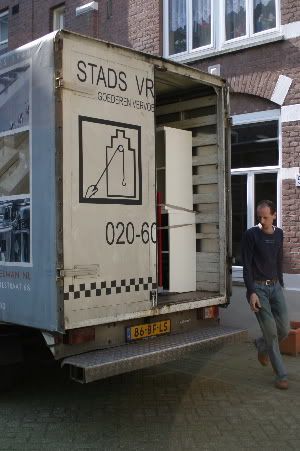
Many thanks to Ton & Bart from Stads Vracht Taxi. If you're going to move in Amsterdam, give them a call 020-606-0789 because they are careful and responsible and very reasonable in cost.
Many thanks to Ton & Bart from Stads Vracht Taxi. If you're going to move in Amsterdam, give them a call 020-606-0789 because they are careful and responsible and very reasonable in cost.
Blognomics 2005 Amsterdam

On April 21st I attended the Blognomics 2005 Symposium at the RAI Conference Center in Amsterdam. Put together by Guido van Nispen and his merry crew, this event shined a spotlight on the landscape of blogging in the Netherlands for us to see. You can access the speakers' presentations here.
What caught my attention was the growing influence of MSN's "Spaces" mini-blog product - expanding on the MSN Messenger platform where people can share more than just words. Within a few months of introduction, MSN Spaces had enlisted more than 500,000 people here in the Netherlands. When you consider that Ilse Media hosts almost 100,000 bloggers on its server of the approximate 250,000 blogs here, MSN Spaces is sweeping up the average person who just wants to share with his immediate community of friends and family. Their connectivity is at an intimate level and enabled with photo sharing.
The more serious bloggers - for both personal and business blogging - are using Ilse Media, Blogger, and MoveableType or Typepad from Six Part.
Another eye-opener for me was the number of serious business bloggers only blogging in the Dutch language. When I read through their blogs, I realized they were hubs for sharing what was happening in their own market and also filtering and adapting the English language trends and concepts into Dutch for distribution. Now I want to discover the Dutch bloggers who are translating the Dutch trends and concepts for global digestion. If you are, please send me your link!
Jonathan Marks and I interviewed some of the speakers and attendees on camera. We caught these speakers: Guido van Nispen our host, Paul Molenaar from Ilse Media, Loic Le Meur from Six Apart, Marco Derksen from his blog MarketingFacts, and Peter Olsthoorn the journalist who publishes Netkwesties. We wanted to capture their thoughts about the impact of blogging and how it's reshaping how we do business. Jonathan will compile these video interviews and post them once he returns from his trip to Mexico City for a conference on the future of broadcasting.
Check out the photos from Blognomics 2005.
Other blogging members of our working group The Dutch Connection were also there: Jonathan Marks, Ton Zijlstra, Elmine Wijnia, and James Burke.
Many of the links to Blognomics 2005 are in the Dutch language because this was a symposium in Dutch for local participants.
20 April 2005
The moving truck broke!
We waited for hours today for the movers to show up. They called and said they were delayed, which I thought was really considerate. Finally, around 4 pm, they just couldn't get their truck fixed or get another arranged in time.
This gave us a chance to put our Zen response into practice - "everything has a reason." We took a couple of very deep cleansing breaths, calmly commiserated with the movers, rescheduled for Saturday and sinply let go. This means sleeping at a friend's house for a couple of days because everything is packed and ready to move. At this point of exhaustion, we just said, "ah...perhaps some rest."
The movers called back and apologized again. Now, I am really impressed.
So, Saturday we move.
This gave us a chance to put our Zen response into practice - "everything has a reason." We took a couple of very deep cleansing breaths, calmly commiserated with the movers, rescheduled for Saturday and sinply let go. This means sleeping at a friend's house for a couple of days because everything is packed and ready to move. At this point of exhaustion, we just said, "ah...perhaps some rest."
The movers called back and apologized again. Now, I am really impressed.
So, Saturday we move.
19 April 2005
Moving this week
Renovating my new apartment has just eaten up my time the past few weeks, Tomorrow is moving day. Once this is behind me, I can focus on the outside world again.
Check back with me in a couple of days. We are involved in so many interesting projects, conferences and efforts right now that I will have lots to share about all of this.
Have a great week!
Check back with me in a couple of days. We are involved in so many interesting projects, conferences and efforts right now that I will have lots to share about all of this.
Have a great week!
9 April 2005
Double Dutch
There are so many sayings with the word "Dutch" in them. Trying to explain them to people who are actually from The Netherlands can be quite funny. When we were growing up, my sister and I played a lot of jump rope. One of the most difficult - but most fun - tricks was with a double strand of rope, where we had to turn each strand into the other and jump both ropes. It required serious rhythm. We called it double-dutch. Now there are competitions for it.
Here are some amazing videos of girls and guys doing double dutch.
Double Duchess

Double Duchess Cat Costumes
Double Dutch in Harlem
Here are some amazing videos of girls and guys doing double dutch.
Double Duchess
Double Duchess Cat Costumes
Double Dutch in Harlem
3 April 2005
Vores ØL - The World's 1st Open Source Beer
A group of students at the IT University in Copenhagen have created Vores ØL - Our Beer, in English - in collaboration with Superflex as an experiment in applying modern open source ideas to methods in traditional real-world product. Superflex plays with social interaction and creative practice to bring new thinking and ways into the mainstream.

You can find everything you want to know about the beer on their Vores ØL site.
This caught my attention because I have worked with beer clients for 30 years. Beer brands struggle with marketing, advertising and promotion because people are no longer susceptible to gimmicks that have traditionally pushed beer sales. People seek out authenticity today. They want to be more than just consumers. That means they are also exploring idealogical alignments.
I wonder how many other product and service brands will follow this. My instincts tell me this is only the beginning of the exploration into how brands can become part of mediated environments and join communities in co-creation of their extended life.
You can find everything you want to know about the beer on their Vores ØL site.
This caught my attention because I have worked with beer clients for 30 years. Beer brands struggle with marketing, advertising and promotion because people are no longer susceptible to gimmicks that have traditionally pushed beer sales. People seek out authenticity today. They want to be more than just consumers. That means they are also exploring idealogical alignments.
I wonder how many other product and service brands will follow this. My instincts tell me this is only the beginning of the exploration into how brands can become part of mediated environments and join communities in co-creation of their extended life.
2 April 2005
Beautiful on the Canals
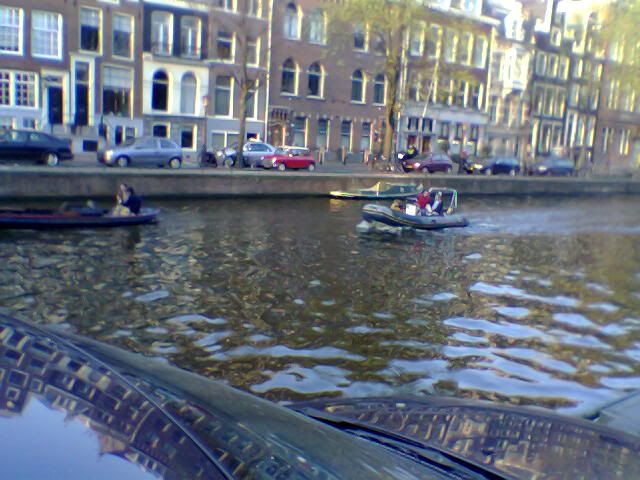
I've been renovating my apartment all week, so I took a spin through the canals this afternoon. Amsterdam is so beautiful when the sun is shining.
Subscribe to:
Posts (Atom)