This past week has brought many loose ideas, people and ways together through my on-going close-out-the-year conversations. The one issue that keeps rising to the surface in almost all of those discussions is personal leadership.
My prediction for 2006 is simple:
People will spend more time packaging their talents, skills and connections in new ways to make themselves more relevant for communities and organizations much more aligned with what they believe in and what they want to achieve that delivers human, social, creative and financial value.
That means that the role of coaches and guides will become more important than ever before if organizations are going to get the right talent in the right roles.
I wish you a year filled with joy, adventure and wonder for 2006.
30 December 2005


27 December 2005
Looking back on 2005
As I look back on 2005 to take a measurement of what happened, what created new value, and what I said goodbye to, I realize that I rarely look back. I am always so busy with the here and now that I often do not take the time to review and evaluate on a longer term "look back".
I want to review what created "impact" in my life on a new value level. Over the next few days, I am taking the time to really have a look at what has impacted my personal world, my working world, my creative world, my academic world and my inner world.
Just off the top of my head, I can immediately see that my partners in IFCCC have contributed to my growth and enjoyment of work and life. New technology always plays a role, but in 2005 I realized that capturing sets of tools and applying new technology could be a new value path. This also has something to do with realizing that I can repackage much of my content and repurpose it to create value in new environments and for new groups of people.
2005 was a year of letting go of old ways - mostly old family habits - and giving myself permission to make myself the center of my own world and not feel obliged to always do what's expected. So, I surprised people this year and shared myself in a new ways. I think this was connected to a renewed yoga practice because of a very special teacher.
So, I am drawing and mapping out what impacted my life and created value in 2005. With that in hand, I will map out a new vision for moving forward with some solid steps for repackaging many of my "products" and services so that I can use them to help others become more collaborative, more creative and more connected.
Internet has 1 Billion Users!
Just discovered this on Web Pro News, and I'm still trying to get my head around what the read implications of this could be.
One Billion Web Users Need Better Websites
By: Jason Lee Miller
Some time this year, the number of Internet users reached one
billion. Billion with a "b." If you count to one billion at one
number per second, it would take you over 31 years to finish. It has
taken the Internet 36 years to count that high, says web usability
expert and former Sun Microsystems engineer Dr. Jakob Nielsen. The
next 10 years will bring the second billion, growing at an annual
rate of 18 percent, and will include unprecedented numbers from Asia
and senior citizens-and that has huge implications in e-commerce.
Statistically, says Nielsen, the one billionth online user was a
24-year-old woman in Shanghai. Only 23 percent come from North
America, leaving 24 percent in Europe and 36 percent in Asia. By
2015, though accounting for nearly one-third of e-commerce, North
Americans will consist of only 15 percent of Internet users.
"This means that for e-commerce to fulfill its potential to double,
sites must be more systematic at following the e-commerce usability
guidelines. Selling to the 200 million early adopters was easy. The
800 million mainstream users who are now starting to shop need much
smoother sites; the next billion will require even higher usability
levels," writes Nielsen.
22 December 2005
Charles Dickens Festival Amsterdam
Last Sunday, the 18th of December, we filmed and photographed the Charles Dickens Festival on Da Costaplein in Amsterdam. This was a neighborhood event organized by Monique Jansen.
Monique's 91 year old grandmother is my neighbor, so they knew I was busy with filming things because I am always carrying camera equipment around. They asked me in the summer if I would film the event. I actually felt honored because it meant they saw me as part of the community and the neighborhood.
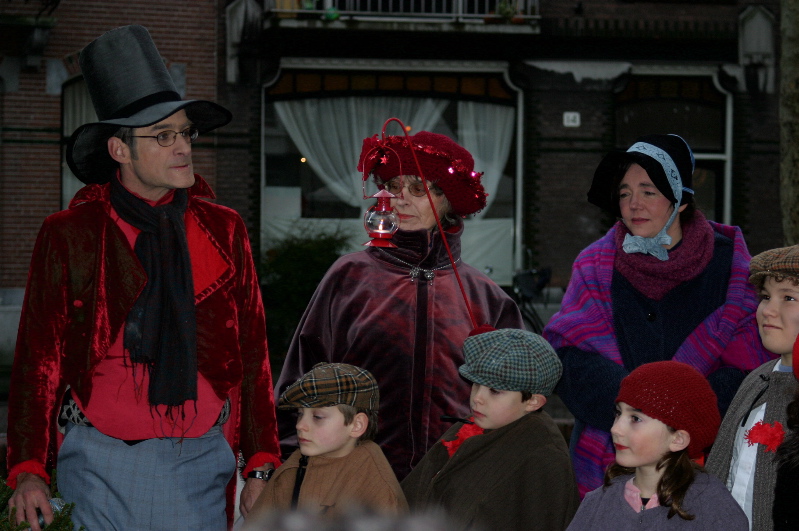
This was a magical day. In 18 years of living here, I had never experienced such a sense of community, sharing, and enjoyment. There were stands with soup and hot mulled wine or hot chocolate. Kids performed their version of Dickens' The Christmas Story with Tiny Tim and Scrooge. People wandered about in period costumes. A sort of "Barber Shop Quartet" sang old standards - and, of course, there were carolers and dancers, too.
The atmosphere was rich in smells, sounds and colors - like stage set for theater, which it was, for 6 hours. One performance after another, effortlessly, and seemingly integrated with the audience. We even had snow blowing around.

Have a look at the photos from the day. I am still busy editing the video, but the cuts look good. Jonathan Marks and Sierd Loman did a great job with the camera work - many thanks to them.
Monique's 91 year old grandmother is my neighbor, so they knew I was busy with filming things because I am always carrying camera equipment around. They asked me in the summer if I would film the event. I actually felt honored because it meant they saw me as part of the community and the neighborhood.
This was a magical day. In 18 years of living here, I had never experienced such a sense of community, sharing, and enjoyment. There were stands with soup and hot mulled wine or hot chocolate. Kids performed their version of Dickens' The Christmas Story with Tiny Tim and Scrooge. People wandered about in period costumes. A sort of "Barber Shop Quartet" sang old standards - and, of course, there were carolers and dancers, too.
The atmosphere was rich in smells, sounds and colors - like stage set for theater, which it was, for 6 hours. One performance after another, effortlessly, and seemingly integrated with the audience. We even had snow blowing around.
Have a look at the photos from the day. I am still busy editing the video, but the cuts look good. Jonathan Marks and Sierd Loman did a great job with the camera work - many thanks to them.
21 December 2005
Hopi Elders Speak
This is for my friend, Kerry Santo, who is struggling right now as she tries to bring an idea movement alive called Modo Fac Central.
This piece was delivered by The Elders, Oraibi, Arizona, Hopi Nation:
"You have been telling the people that this is the Eleventh Hour.
Now you must go back and tell the people that this is The Hour.
There are things to be considered:
Where are you living?
What are you doing?
What are your relationships?
Are you in right relation?
Where is your water?
Know your garden.
It is time to speak your Truth.
Create your community.
Be good to each other.
And do not look outside yourself for the leader.
This could be a good time!
There is a river flowing now very fast.
It is so great and swift that there are those who will be afraid.
They will try to hold on to the shore.
They will feel they are being torn apart, and they will suffer greatly.
Know the river has its destination.
The elders say we must let go of the shore, push off into the middle of the river, keep our eyes open, and our heads above the water.
See who is in there with you and celebrate.
At this time in history, we are to take nothing personally. Least of all, ourselves.
For the moment that we do, our spiritual growth and journey comes to a halt.
The time of the lone wolf is over.
Gather yourselves!
Banish the word struggle from your attitude and vocabulary.
All that we do now must be done in a sacred manner and in celebration.
We are the ones we've been waiting for."
15 December 2005
Yahoo!-li.cio.us
Joshua Schachter sold Del.icio.us to Yahoo last week! That takes tagging into the mainstream now. I wonder whether Yahoo! is going to try and combine or somehow blend My Web2.0 into Del.icio.us.
It's interesting to watch how Yahoo! is building its innovative strength by buying unique and successful social media brands that have opened up categories - like Flickr (for photo storage, sharing and tagging) and Del.icio.us (for bookmark storage, sharing and tagging). Nice strategy to compete with Google, who innovates by invention.
Makes me wonder who's next? Could be that ex-Yahoolian, Seth Godin, had an instinct when he started Squidoo. Speaking of Squidoo, they are struggling with a wee bit of technical difficulty today. I really do love developing those Squidoo lenses.
14 December 2005
Technorati Kitchen - What's Cooking?
Technorati Kitchen is a place where you can explore the hottest blogs on any topic.

You can post projects that are not ready for the world but need feedback. You can contribute things to do with gadgets or announce great new ones. You can learn about new tools for design or technology or make the connections for venture capital.
The right-hand column lists contributions that are "fully baked" or "half baked".
There's even a feedback form to help Technorati further develop this concept of exploring.
12 December 2005
An Evening Crossing Signals on Innovation
Last Wednesday evening, I attended a knowledge sharing session hosted by Crossing Signals at Kasteel Wittenburg.

Rudy Hoeboer is championing collaboration at the business level to stimulate innovative thinking and practices between people at work. He and Mathijs van Zutphen opened the evening with a discussion about the philosphy behind collaboration and innovation. They then introduced Valeri Souchkov from ICG Training & Consulting.
Valeri presented us with the background to TRIZ, Systematic Innovation Techniques. We even got to play with a "contradiction". I love using this word instead of problem. If I walked away with anything from that evening, it is using this word "contradiction", perhaps because it's a word with perspective, whereas "problem" has such a judgment attached to its meaning. Valeri asked us to choose a positive and a negative contradiction so that he could demonstrate how TRIZ works.
Ton presented a wonderful set: negative = too many resources and time to bring in business; positive = smaller projects much better aligned with strengths and desires to generate more satisfaction.
Valeri used his matrix to identify which principles we should apply. There are 5 levels of innovation, and most companies remain working at level one. Even the most brilliant and innovative rarely generate new thinking or ideas at a level higher than 3. Level 5 requires changes principles. The one principle that stimulated our thinking the most was "holes" - look for the holes, spaces, gaps, missing pieces.
I am interested in playing around a bit more with Valeri on developing a visual software for clarifying the meaning of concepts that take on different meaning in different cultures. We'll see what happens.
Thanks, Rudy, for the invitation...and apologies for the incredible mispelling of your last name! (I'm still giggling...)
8 December 2005
Parallel DNS System Proposed by Dutch Company
A Dutch company - UnifiedRoot - is introducing a new generation of internet domain names "around the dot". They are offering top level domains (TLD's) with sub-level domains using the name of a person or the company, or actually any name we choose, as the suffix.
This means we can really personalize our domains and clean up the web architecture for our sites. Instead of having to claim several domains - ifccc.org, ifccc.com, ifccc.net, etc. - we could just claim our name as the suffix and then use that to build a more cohesive web domain archtecture. For instance, instead of IFCCC.org, we could use www.wiki.ifccc or www.forum.ifccc or www.projects.ifccc. We could then adapt our email to colby@amsterdam.ifccc or jonathan@london.ifccc. This makes a lot of sense.
This new generation domain system proposed by UnifiedRoot offers us a much more intuitive way to build our Internet addresses and web architecture. This has lots of benefits for users - easy to remember, easy to navigate, less confusion with other companies, branded and personalized.

UnifiedRoot has already established 13 master root servers around the world to handle this domain name system (DNS).
By doing this, UnifiedRoot creates a contradiction for the Internet's principle DNS, run by the Internet Corporation for Assigned Names and Numbers (ICANN), because it establishes a parallel DNS system.
What does this mean for our ISP's? They will need to add these newly established DNS servers from UnifiedRoot in their DNS server directories. European ISP Tiscali has already made the change, along with several local ISPs in Turkey.
We're always looking for examples of real innovation here in The Netherlands - well, this is definitely one!
Unified Root is a B.V. based in Amsterdam, and their managing director is Erik Seeboldt.
This means we can really personalize our domains and clean up the web architecture for our sites. Instead of having to claim several domains - ifccc.org, ifccc.com, ifccc.net, etc. - we could just claim our name as the suffix and then use that to build a more cohesive web domain archtecture. For instance, instead of IFCCC.org, we could use www.wiki.ifccc or www.forum.ifccc or www.projects.ifccc. We could then adapt our email to colby@amsterdam.ifccc or jonathan@london.ifccc. This makes a lot of sense.
This new generation domain system proposed by UnifiedRoot offers us a much more intuitive way to build our Internet addresses and web architecture. This has lots of benefits for users - easy to remember, easy to navigate, less confusion with other companies, branded and personalized.
UnifiedRoot has already established 13 master root servers around the world to handle this domain name system (DNS).
By doing this, UnifiedRoot creates a contradiction for the Internet's principle DNS, run by the Internet Corporation for Assigned Names and Numbers (ICANN), because it establishes a parallel DNS system.
What does this mean for our ISP's? They will need to add these newly established DNS servers from UnifiedRoot in their DNS server directories. European ISP Tiscali has already made the change, along with several local ISPs in Turkey.
We're always looking for examples of real innovation here in The Netherlands - well, this is definitely one!
Unified Root is a B.V. based in Amsterdam, and their managing director is Erik Seeboldt.
6 December 2005
Squidoo is almost ready for release!
Though it is still in beta mode, Seth Godin has once again created a whazzo marketing tool for ideas - Squidoo.

Squidoo is an online social application equipped with RSS, a module formatted template, supported by Google Ads, and has a network of lenses created by individuals about their specialities.

Many of us have been developing lenses, playing with how to put them together, and feeding back through a dynamic Squidoo team. Why have we been doing this? First, it's FUN! But, more importantly, Squidoo is a tool for showcasing ideas, topics, business practices. It's easy-to-read-and-find format creates a "lens" or filter through which viewers can find, learn and access the information about that subject matter.
Because we tag our lenses and keep them "live" through RSS feeds and updated links, they are perfect formats for Google Ads. Once Squidoo is out of beta, each lens will become a revenue stream for the developer of the lens - as well as a window into their expertise or knowledge or connections to a certain topic.
Anyway, I've had fun building some lenses and sharing my feedback. Here's a preview into one of the lenses I built: Squidoo Lens: How to Connect Using SocialMedia
Here's the list of the TOP 100 Squidoo Lenses.
Once Squidoo is out of beta, you should build lenses too and connect them to your site or blog or use them to market yourself.
Squidoo is an online social application equipped with RSS, a module formatted template, supported by Google Ads, and has a network of lenses created by individuals about their specialities.
Many of us have been developing lenses, playing with how to put them together, and feeding back through a dynamic Squidoo team. Why have we been doing this? First, it's FUN! But, more importantly, Squidoo is a tool for showcasing ideas, topics, business practices. It's easy-to-read-and-find format creates a "lens" or filter through which viewers can find, learn and access the information about that subject matter.
Because we tag our lenses and keep them "live" through RSS feeds and updated links, they are perfect formats for Google Ads. Once Squidoo is out of beta, each lens will become a revenue stream for the developer of the lens - as well as a window into their expertise or knowledge or connections to a certain topic.
Anyway, I've had fun building some lenses and sharing my feedback. Here's a preview into one of the lenses I built: Squidoo Lens: How to Connect Using SocialMedia
Here's the list of the TOP 100 Squidoo Lenses.
Once Squidoo is out of beta, you should build lenses too and connect them to your site or blog or use them to market yourself.
5 December 2005
Google Calendar Expected Tomorrow
Just in from Inside Google blog Google Calendar Expected Tomorrow Read whole story there.
"Rumor is that Google will unveil the long-ago rumored Google Calendar at Tuesday’s When 2.0 conference at Stanford. Will Google Calendar use some company’s calendar format, a brand-new incompatible format , offer converters from but not to other formats , or will Google do the smart and diplomatic thing? Will Google Calendar steal some of Microsoft’s thunder and support RSS SSE?"
via Inside Google and Findory
Sinterklaas 5 December
This evening, most Dutch families will celebrate Sinterklaas with presents, poems and candies. It is a very intimate family tradition.

Sinterklaas arrives in each Dutch town on a big white horse and has a big red book with the names of all children and how they have behaved over the past year. If a child has been good, they get a present and a chocolate letter of the initial from their first name with traditional candies and cookies. If a child has been naughty, he expects to get "lashed" with the branches from "Black Pete", one of Sinterklaas' assistants - and then get stuffed into Sinterklaas' bag and taken to Spain for the year to learn how to behave.
Every child knows this will never happen, but parents use the threat anyway because it is part of their tradition.
Grown-ups give each other a "review" of the past year in rhyme, which gives them a chance to say what they've wanted to say all year long about each other.
St. Nickolas was originally a bishop in the town of Mira in southern Turkey hundreds of years ago. He was left an orphan with a large inheritance, which he unselfishly spent on all the people and, particularly, children in need.
Black Pete is actually a bit of a politically incorrect character in these days with his painted black face.
I can't wait to share the poems tonight!
1 December 2005
The Future of Software Architecture
Yesterday evening, I attended a "speaker & discussion event" - The Future of Software Architecture - put together by The Club of Amsterdam. It was held in the offices of Syntens.
The discussion after the speakers covered a wide scope of views. The heart of the discussion wasn't really about software architecture, but more along the lines of people's and society's relationship with business. The core issue about the future of software architecture seemed to lie somewhere between:
.....having enough time to invest in developing real solutions rather than holding the solution hostage by business politics
.....and educational standards that leave children without the knowledge to contribute at a level higher than business tasking.
What I also heard - from those not involved in the field of computer sciences - was a voice for the human factor and the human value system. Is the role of software keeping our children from learning - or is it helping our children learn differently? Should computers reflect our human capacity for emotion? This raised the conversation to another level until one young man tried to turn the discussion into an instrumental talk about learning about software architecture. Thankfully, the group did not want to let go of the more philosophical discussion about the "future of...".
These discourses stimulated by the Club of Amsterdam help to build our knowledge and give us a venue to share our thinking on topical issues. We meet interesting minds, help address the issues in our society, and grow relationships.
In the beginning of the evening, I though "Uh-oh.." when the host started to literally read from a PowerPoint presentation about her company, Syntens. Rather than share why syntens had hosted the evening and what role they play in the context of the subject, she opted for reading a sales pitch. Lost opportunity to engage themselves in the evening.
Thankfully, that ended quickly and Maarten Boasson, a professor at the University of Amsterdam shared his views on the issues of developing software architecture in today's world. Though Maarten didn't hold out many hopes for the future of software architecture, he did address the stumbling blocks to success. Big issue: clients with their own agenda opting for software development based on an already chosen, politically motivated solution, rather than letting the architect develop a solution based on identified parameters guided by the real problem. Another big issue: the academic standards that leave us with a pool of talent that do not have the abilities needed to think about solutions for addressing the real problems.
The second speaker was Maarten Visser, an young and enthusiastic entrepreneurial evangelist for social software and the value it creates for business, people and society. He visually demonstrated the integration of the different layers of technology their construction into web applications and interfaces.
The third speaker, Niek Jetten, presented the issues facing business right now with integrating new systems with legacy systems.
This gave us three completely different perspectives of approach and interest - as well as age.
28 November 2005
Google's Feed Reader
Has anyone else been playing with Google's Feed Reader?
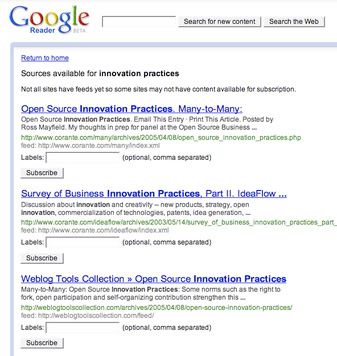
I've been using it to track research. What works for me is being able to do a search and immediately save the feed.
I've been using it to track research. What works for me is being able to do a search and immediately save the feed.
Brand Innovation Practices
Sometimes I take for granted what I do for living. Helping companies build brand innovation practices into their way of doing things can open up opportunities, build new revenue streams and bring people into play with one another. And yet, how many companies are actually investing their time and money into brand innovation? The decision makers still think it costs too much to get a program like this started - or too invasive because it distracts people from attending to the tasks at hand.
With all these wonderful tools and applications and platforms from social media, we're headed into a new frontier in brand innovation practices. For such a long time, we didn't have the easy, affordable and accessible tools to support the programs we would set up for clients. Now, with WiFi and the click of the entry button on our laptops, we're set up and engaging people in teamwork. It enhances what people do because it captures the value of their networking. It's developmental and leads to those new ways, new markets, new opportunities.
What used to take weeks to put together is now accomplished in a few hours...and it's a lot more fun and visual.
27 November 2005
Goodbye, Mr. Miyagi
Though he played other roles, we will always remember Pat Morita as Mr. Miyagi from Karate Kid. He was absolutely zen-cool and made an impression on my son back in the days when very little beyond metal and goth got onto his radar. I wonder how many kids growing up in the 80’s and 90’s will remember him fondly. Couldn’t ask for a better role model with such a great twisted sense of humor.

Pat Morita was only 73 when he died in Las Vegas on 25 November 2005. Goodbye, Mr. Miyagi, and thank you.
Pat Morita was only 73 when he died in Las Vegas on 25 November 2005. Goodbye, Mr. Miyagi, and thank you.
26 November 2005
The Open Directory Project (DMOZ)
Everyone can contribute to The Open Directory Project. It is"the largest, most comprehensive human-edited directory of the Web." You can become an editor and contribute sites that you run across to the various Directory classifications.


No Need to Click Here - I'm just claiming my feed at Feedster
Planzo.com The Online Planning Community
I found an online calendar for sharing with a group. It seems easy to access, share and use. Makes it a whole lot easier when others are trying to book you into their schedules for meetings and events.

Do you use any online planning calendars that you recommend?
Do you use any online planning calendars that you recommend?
Network Maps
Would it help us if we had visualized maps showing us where we are in projects, or with communications and contacts, or with our own personal information system? Wouldn’t it be great to hit a button at any point along the way, and – voila! – a map of all the connections and their hubs?
I've just finished finding all the photos, charts and illustrations for my article on "The Changing Business Model". It would have been so much easier to just have that magic little button labeled "create network map" from some selectively tagged words and images.
I want that button!
I've just finished finding all the photos, charts and illustrations for my article on "The Changing Business Model". It would have been so much easier to just have that magic little button labeled "create network map" from some selectively tagged words and images.
I want that button!
24 November 2005
What creates meaning for us?
What defines our lives? What really creates meaning for us? These are big questions that are touching my life right now. My work world is consumed by helping people get a grip on what creates value and how to use all the wonderfulness of social media to connect us up to do that value. I feel like a broken record sometimes when I keep saying, ”It’s not about the technology, it’s about the people.”
In my private life, my dad’s fragility of health has made me realize how precious simply having fun with someone is. My dad has been in and out of the hospital like a yo-yo recently. He’s in his 80’s and just physically deteriorating. We laughed the last time he came home – at least his shelf life wasn’t up yet.
Clint plays the sax in a band. He loves playing music so much that he goes off to weekly band practice in his wheelchair. It keeps him going and keeps him smiling. He’s been playing swing music since the 40’s, and our house was always filled with music and dancing. My parents met while my dad was playing and my mom was dancing. His instrument of choice has always been his “licorice stick”, the clarinet, which is only one of the instruments that he has played since childhood. His fingers aren’t nimble enough anymore to really work the keys, so he switched over to his sax, which requires a lot less finger action, and still gives him a place in the band. I think – in looking back – that he would have preferred to have played music for his professions than to have had a great business career. Imagine that. Playing music creates deep meaning for him in his life – and we grew up surrounded by that meaningful presence of music and dance. Basically, life is a party.

"Photo thanks to © Karlheinz Klüter from www.jazzphotography.us"
When we no longer can define our lives by stuff that creates meaning for us, what happens? Here’s another question: “Are we content with work when it doesn’t create meaning for us?” Is it possible to create a meaningful work life with everyone around us? What would we have to do? What kind of dialogue do we have to open with others?
How do we measure meaning? Instead of counting just money as the only measurement of value creation, what would happen if we could generate a list of stuff that creates meaning for us in the context of our work? Are we already changing how we come together to create value in our lives through our work? Is that why we are migrating with such ease into the new tool set available through social media?
For me, the beauty is in the relationships – and not just between people. I can change something by doing it in a different way and in a new context and get such joy from it. If the relationships are healthy and aligned, then I derive tremendous satisfaction from what I do. And…money follows that. I love doing what I do, and I made a decision to no longer work with people or clients that are bullies. I just say no to te stuff that no longer creates meaning for me.
I want to make a series of filmed interviews and podcasts on what creates meaning in our work life for my next creative project.
What’s the “music” that creates meaning for you in your work life? If you would like to share your thoughts about what creates meaning for you in your work, please let me know so that we can set a date to film this interview.
In my private life, my dad’s fragility of health has made me realize how precious simply having fun with someone is. My dad has been in and out of the hospital like a yo-yo recently. He’s in his 80’s and just physically deteriorating. We laughed the last time he came home – at least his shelf life wasn’t up yet.
Clint plays the sax in a band. He loves playing music so much that he goes off to weekly band practice in his wheelchair. It keeps him going and keeps him smiling. He’s been playing swing music since the 40’s, and our house was always filled with music and dancing. My parents met while my dad was playing and my mom was dancing. His instrument of choice has always been his “licorice stick”, the clarinet, which is only one of the instruments that he has played since childhood. His fingers aren’t nimble enough anymore to really work the keys, so he switched over to his sax, which requires a lot less finger action, and still gives him a place in the band. I think – in looking back – that he would have preferred to have played music for his professions than to have had a great business career. Imagine that. Playing music creates deep meaning for him in his life – and we grew up surrounded by that meaningful presence of music and dance. Basically, life is a party.
"Photo thanks to © Karlheinz Klüter from www.jazzphotography.us"
When we no longer can define our lives by stuff that creates meaning for us, what happens? Here’s another question: “Are we content with work when it doesn’t create meaning for us?” Is it possible to create a meaningful work life with everyone around us? What would we have to do? What kind of dialogue do we have to open with others?
How do we measure meaning? Instead of counting just money as the only measurement of value creation, what would happen if we could generate a list of stuff that creates meaning for us in the context of our work? Are we already changing how we come together to create value in our lives through our work? Is that why we are migrating with such ease into the new tool set available through social media?
For me, the beauty is in the relationships – and not just between people. I can change something by doing it in a different way and in a new context and get such joy from it. If the relationships are healthy and aligned, then I derive tremendous satisfaction from what I do. And…money follows that. I love doing what I do, and I made a decision to no longer work with people or clients that are bullies. I just say no to te stuff that no longer creates meaning for me.
I want to make a series of filmed interviews and podcasts on what creates meaning in our work life for my next creative project.
What’s the “music” that creates meaning for you in your work life? If you would like to share your thoughts about what creates meaning for you in your work, please let me know so that we can set a date to film this interview.
23 November 2005
Microsoft Sharing?!
Microsoft is making a stab at supporting the Creative Commons’ Attribution-ShareAlike license.
Under this Creative Commons License, Microsoft released the specification for Simple Sharing Extensions (SSE) , which turns RSS bi-directional. For example, SSE should make sharing calendars and contact lists easier.
The objective of Simple Sharing Extensions (SSE) is to define the minimum extensions necessary to enable loosely-cooperating apps 1. to use RSS as the basis for item sharing – that is, the bi-directional, asynchronous replication of new and changed item. Basically, it uses the reverse exchange of RSS.
I try as much as possible to not get entrapped by anything produced by MS. Being a committed Apple flag-waver, I believe in OpenSource, fair trade, sharing and collaboration. Because MS is making an attempt to share, I want to support their efforts…so they’ll do it more. Just hope we don’t end up with some strange leak into the etherworld.
Ray Ozzie, Chief Technical Officer of Microsoft, has a blog on MSN Spaces. In his posting on SSE, he talks about why the decided to do this. Wow.
Put Technorati Mini in Your Firefox Sidebar
I just read in the Technorati Weblog that they have launched a new feature called Technorati Mini. It keeps a blog search live in a pop-up window.

In his Micro Persuasion blog, Steve Rubel show us how to put Technorati Mini in the Firefox Sidebar
Follow Steve's instructions to get it into your Firefox sidebar.
1) Visit Technorati mini and enter your search
2) Bookmark the pop-up window
3) Change the properties of the bookmark so that "load this bookmark in the sidebar" is checked
4) Fill in the keyword field in the word box. Then all you'll need to do to activate Technorati Mini is to type that word in the URL field.
Neuroscientists decipher part of code for visual recognition
Neuroscientists decipher part of code for visual recognition>
We learn so much through simply seeing something. Up until now, scientists have not understood enough about how the brain codes and decodes information...though they do not so much more than a few years ago.
Just recently, neuroscientists in the McGovern Institute at MIT have deciphered part of the code involved in recognizing visual objects. An immediate application would be for computer algorithms used in artificial vision systems. This could enhance how they mimick these newly uncovered codes.

"We want to know how the brain works to create intelligence." According to Tomaso Poggio, the Eugene McDermott Professor in Brain Sciences and Human Behavior, "Our ability to recognize objects in the visual world is among the most complex problems the brain must solve. Computationally, it is much harder than reasoning. Yet we take it for granted because it appears to happen automatically and almost unconsciously." You can find out more through his lab - The Center for Biological & Computational Learning.
Since part of my fascination with life lies in the study of consciousness, I am continually impressed with the depth and capacity of our minds to explore the world of the unknown.
We learn so much through simply seeing something. Up until now, scientists have not understood enough about how the brain codes and decodes information...though they do not so much more than a few years ago.
Just recently, neuroscientists in the McGovern Institute at MIT have deciphered part of the code involved in recognizing visual objects. An immediate application would be for computer algorithms used in artificial vision systems. This could enhance how they mimick these newly uncovered codes.
"We want to know how the brain works to create intelligence." According to Tomaso Poggio, the Eugene McDermott Professor in Brain Sciences and Human Behavior, "Our ability to recognize objects in the visual world is among the most complex problems the brain must solve. Computationally, it is much harder than reasoning. Yet we take it for granted because it appears to happen automatically and almost unconsciously." You can find out more through his lab - The Center for Biological & Computational Learning.
Since part of my fascination with life lies in the study of consciousness, I am continually impressed with the depth and capacity of our minds to explore the world of the unknown.
LivePlasma
Want to see other stuff that's linked to what you like in music and film? Then LivePlasma is a fun tool to use to visually map out films, directors, music, or artists into a network of connections.

I had fun, but found it a bit annoying that the navigation tool sits right on top of what you need to see, and you can't move it...at least with Firefox.
I had fun, but found it a bit annoying that the navigation tool sits right on top of what you need to see, and you can't move it...at least with Firefox.
21 November 2005
Semantics & Folksonomies
Tagging has raised all sorts of interesting behaviors in individuals – and assumptions as well. Even as we track the changes in how people tag different bookmarks over at Delicious, we learn that people have started using “Web 2.0” as a tag in place of “web”. Is this because they are influenced by what they’re reading? Are they effectively adapting their tagging to the lingua franca in use at the moment?
I’ve been using decks of photo cards to help groups and teams see how the same team members will each choose a different name or tag to describe the same photos. It’s also a fun way to open the issue about sharing a common language when we try to explain concepts to people. When one team member hears the other describing the same photo or concept, but completely differently than what another said, a deeper conversation begins to develop. They then realize that having a way to break through these assumptions is very important. If they want to have consistent engagement with their clients, they all need to share the same vocabulary to describe things.

Great example: “Vlogging” is a term one of them used. Another jumped in and corrected him and said it was called “video-casting”. Another said it was called “video-blogging”. Another said he had never heard of any of these terms and simply called it a “film clipping”. Is there only one correct term to use? Or, is more important that we understand that we’re all talking about the same thing?
I think this a personal perspective on language use. It depends on what kind of person you are. If you are precise and rigid and follow a specific methodology, then you would choose a term that you think is the accepted term. If you are someone who is quick with intellect, flowery with description, you might choose different terms on different occasions. There are so many dimensions, perspectives, filters and mindsets.
Perhaps we will start congregating around the shared tags we use. If we use a common language and we can find others using the same, then that creates a new community for us. Joshua Schachter from Del.icio.us is busy setting up a social networking platform based on sharing tags and bookmarks. He says that Del.icio.us is about remembering.
This once again demonstrates a need for understanding what creates meaning for us. For us to be able to do that, we have to understand how different personalities play into one another. It changes our perspectives and filters for exchange and understanding. Meaning is very contextual.
What creates meaning for you - words, pictures, sounds, smells....????
I’ve been using decks of photo cards to help groups and teams see how the same team members will each choose a different name or tag to describe the same photos. It’s also a fun way to open the issue about sharing a common language when we try to explain concepts to people. When one team member hears the other describing the same photo or concept, but completely differently than what another said, a deeper conversation begins to develop. They then realize that having a way to break through these assumptions is very important. If they want to have consistent engagement with their clients, they all need to share the same vocabulary to describe things.
Great example: “Vlogging” is a term one of them used. Another jumped in and corrected him and said it was called “video-casting”. Another said it was called “video-blogging”. Another said he had never heard of any of these terms and simply called it a “film clipping”. Is there only one correct term to use? Or, is more important that we understand that we’re all talking about the same thing?
I think this a personal perspective on language use. It depends on what kind of person you are. If you are precise and rigid and follow a specific methodology, then you would choose a term that you think is the accepted term. If you are someone who is quick with intellect, flowery with description, you might choose different terms on different occasions. There are so many dimensions, perspectives, filters and mindsets.
Perhaps we will start congregating around the shared tags we use. If we use a common language and we can find others using the same, then that creates a new community for us. Joshua Schachter from Del.icio.us is busy setting up a social networking platform based on sharing tags and bookmarks. He says that Del.icio.us is about remembering.
This once again demonstrates a need for understanding what creates meaning for us. For us to be able to do that, we have to understand how different personalities play into one another. It changes our perspectives and filters for exchange and understanding. Meaning is very contextual.
What creates meaning for you - words, pictures, sounds, smells....????
20 November 2005
Geo-Tagging & Ambient Findability
After a conversation about geo-tagging with Ton Zijlstra last Thursday, my antenna are obviously now picking up on anything related to location, tracking and the possibilities that roll from that. This is a focus of his. Several months ago, he turned us on to Plazes.com, a nifty web service that let's you find people in your vicinity, and even available wifi. Plazes.com is cool because it visually brings you into an environment with photos and maps, so that you can see where you are in context of others - or in relation to the nearest available wifi. You connect through geographic accessibility.
Findability seems to be an emerging key strategy...not just people but information, connections, places, things.
With this in my head, I ran across an article from the Linux Journal on "Geotagging Web Pages and RSS Feeds", which is more about working with the technology for tagging websites than the networks it can create. Still, it fed into my thinking about how location technology enables us to do so much and to connect in so many different ways.
Last month, I read a great piece on Ambient Findability from Peter Morville. This led me to tracking the bookmarks at Del.icio.us/livlab/ambientfindability.
What I see happening is a convergence into web-based services sites that allow us to co-develop social applications that help us connect ourselves - our content, our location and our way of behaving with others - with others and their content, location and ways. This is another form of social networking based on finding others with a shared interest, purpose, or just location.

Visualizing what we need to find is also important to finding it. What if you had a tag cloud floating close by, continually fed by your Del.icio.us bookmarks. You could just have a peek, tap it and connect to your resources. Of course, this means we have to start refining our tags into relevant category streams.
.
Findability seems to be an emerging key strategy...not just people but information, connections, places, things.
With this in my head, I ran across an article from the Linux Journal on "Geotagging Web Pages and RSS Feeds", which is more about working with the technology for tagging websites than the networks it can create. Still, it fed into my thinking about how location technology enables us to do so much and to connect in so many different ways.
Last month, I read a great piece on Ambient Findability from Peter Morville. This led me to tracking the bookmarks at Del.icio.us/livlab/ambientfindability.
What I see happening is a convergence into web-based services sites that allow us to co-develop social applications that help us connect ourselves - our content, our location and our way of behaving with others - with others and their content, location and ways. This is another form of social networking based on finding others with a shared interest, purpose, or just location.
Visualizing what we need to find is also important to finding it. What if you had a tag cloud floating close by, continually fed by your Del.icio.us bookmarks. You could just have a peek, tap it and connect to your resources. Of course, this means we have to start refining our tags into relevant category streams.
.
Satellite Culture – Are we being watched?
Are we naïve? I watched a program about the power of private defense contractors to the military in several countries. It made me really think about how naïve we really may be.
Satellites can find us anywhere on earth through our mobile phones, our automobiles or some other digital signal. They can see and hear almost everything we do. This realization makes us aware of the importance of our own security and privacy.
This also works the other way around. With access to those satellites in space, we can make contact, see and hear almost anyone or anywhere. But, we are not the ones with access.
Who’s watching the space cowboys who are watching us? Do we need to be concerned? What are they doing with the information that they collect on us? Are we part of a program called Dynamic People Management?
Google Maps has people talking. The resolutions are minimal compared to the government satellites that can identify objects 6 inches apart. (This is certainly far better than plugging in your coordinates from your mobile to Google Maps and seeing your location.) That means “they” can read your newspaper over your shoulder from outer space. Who contracts the government satellites and how do they use the information they collect?
Who’s controlling space? No one owns it. Everyone puts satellites into space. How do we know that there are not satellites with laser capabilities aimed at strategic locations on earth?

Telelcommunication, GPS, weather satellites play role in our lives. Are satellites with military application in conflict with our beliefs if they can instigate war? Does satellite garbage endanger our telecommunications or weather? Can the nuclear debris from plutonium-enriched rockets that launch satellites into space fall back into the earth atmosphere and harm us?
What are the true benefits of satellites? Are we just moving forward blind to the consequences because we are too busy enjoying the benefits of expanded media and communications, our mobile phones and all the other toys coming into our lives?
.
Satellites can find us anywhere on earth through our mobile phones, our automobiles or some other digital signal. They can see and hear almost everything we do. This realization makes us aware of the importance of our own security and privacy.
This also works the other way around. With access to those satellites in space, we can make contact, see and hear almost anyone or anywhere. But, we are not the ones with access.
Who’s watching the space cowboys who are watching us? Do we need to be concerned? What are they doing with the information that they collect on us? Are we part of a program called Dynamic People Management?
Google Maps has people talking. The resolutions are minimal compared to the government satellites that can identify objects 6 inches apart. (This is certainly far better than plugging in your coordinates from your mobile to Google Maps and seeing your location.) That means “they” can read your newspaper over your shoulder from outer space. Who contracts the government satellites and how do they use the information they collect?
Who’s controlling space? No one owns it. Everyone puts satellites into space. How do we know that there are not satellites with laser capabilities aimed at strategic locations on earth?
Telelcommunication, GPS, weather satellites play role in our lives. Are satellites with military application in conflict with our beliefs if they can instigate war? Does satellite garbage endanger our telecommunications or weather? Can the nuclear debris from plutonium-enriched rockets that launch satellites into space fall back into the earth atmosphere and harm us?
What are the true benefits of satellites? Are we just moving forward blind to the consequences because we are too busy enjoying the benefits of expanded media and communications, our mobile phones and all the other toys coming into our lives?
.
14 November 2005
Google Analytics
Want to know more about your site or blog? Want to know which keywords work and which ones don't? Want to know how visitors to your site found you and what they visited in your site?
Sign up for Google Analytics while it's still free and find out.

Here's their promise: "Instead of spending money on web analytics, you can focus on creating targeted, ROI-driven marketing campaigns, and on improving your site design and content."
I'm off to experiment with it now. The first try gave me an error message "Currently Undergoing Maintenance. Google Analytics reporting is currently undergoing maintenance and will be available shortly. Your site traffic is being logged and you will be able to see the data after system maintenance has concluded."
Sign up for Google Analytics while it's still free and find out.
Here's their promise: "Instead of spending money on web analytics, you can focus on creating targeted, ROI-driven marketing campaigns, and on improving your site design and content."
I'm off to experiment with it now. The first try gave me an error message "Currently Undergoing Maintenance. Google Analytics reporting is currently undergoing maintenance and will be available shortly. Your site traffic is being logged and you will be able to see the data after system maintenance has concluded."
13 November 2005
Load your Firefox Bookmarks into Del.icio.us
I forgot how handy this tool is. Since I've spent the last couple of weeks deep in the construction and writing of an article and a seminar series, I've been doing small tasks during my breaks.
One of those small tasks was taking all my bookmarks, organizing them into better categories and exporting/importing them into the three browsers I use. While doing that I ran across this wonderful tool from Julian Bez that had completely slipped my mind.
"The powerful del.icio.us loader loads your Firefox bookmarks directly into your del.icio.us account!"

Give it a try. Do not load more than 40 bookmarks at a time - oh, and have some patience.
One of those small tasks was taking all my bookmarks, organizing them into better categories and exporting/importing them into the three browsers I use. While doing that I ran across this wonderful tool from Julian Bez that had completely slipped my mind.
"The powerful del.icio.us loader loads your Firefox bookmarks directly into your del.icio.us account!"
Give it a try. Do not load more than 40 bookmarks at a time - oh, and have some patience.
12 November 2005
Personal Learning Environments
Stephen Downes writes an extensively researched and referenced blog about higher education that I follow and learn from on a regular basis. Last week he posted something that caught my eye for two reasons. The first was the logo:

The second was research on PLE - personal learning environments.
Stephen quotes
Graham Attwell from the Wales-Wide Web: "Instead of the learner logging in to a university based system the leaner is able to integrate multiple contexts and sources of learning and develop their own 'learning mix'. Moreover this promises to be of use to the many, many thousands of learners who are not registered with educational institutions. It may even force institutions to reflect on their role in supporting - rather than defining - learning and knowledge."
He's referring to research by Scott Wilson from Bolton University. They'll present the Personal Learning Environment Theme at a conference this coming week. They are addressing the hard issues of conflict between proprietary VLEs (virtual learning environments) and the need for individuals to have cross-institutional or non-institutional PLEs (personal learning environments).
This interests me because we are continually building toward a platform that enables us as individuals to learn, share, work, collaborate, and create from own own center, irrelevant of the differents academic or professional or creative working groups.
9 November 2005
An Innovative School - Empire High
Students at Empire High School work in classrooms with a videoscreen instead of a blackboard, and each of the 750 students receives an Apple iBook laptop computer in place of a pile of textbooks. The teachers are using technology as context for tools, content and learning. "We want to educate students for the work world that they will soon be entering where technology is integrated into most jobs and careers."
Cindy Lee is Principal of Empire High School gave an interview on BBC World yesterday. She said their reason for developing a school like this was to face the challenge of keeping students engaged in learning. I like this mindset of teaching students how to learn rather than teaching them just about topics. I also think it will give students a chance to develop their own learning styles.
Finally, a school focused on preparing students for the future using the comtemporary tools that are shaping society today. By learning this way, students are not stuck with antiquated academic books that are their only reference to support what teachers are presenting to them. Now, they are directed to online resources that are up-to-date and reflective of contemporary contexts.
I can't wait to see how this impacts learning and knowledge absorption. I wonder if it will also cut down on kids skipping classes and leaving school before graduation. Hopefully, it will raise the current levels of academic standards in public schools.
Subscribe to:
Posts (Atom)