What I am beginning to recognize more and more are the apparent gaps created between those engaging with social media and those who do not know of its tools or the impact of those tools. Older people fall into this gap regularly - during business meetings, while traveling, in their families, and even in their art galleries.
I received an invitation to an art exhibition of photography by recognized older artists in Friesland. What amazed me was that the photographic composition and capture had nothing differentiating it from the hundreds of photos we see every day, shared through our mobile phones, Flickr, and all the other social media tools. How will these artists feel when they discover that what they hold precious is now shared as a common occurance daily by millions?
What happens when business people leading corporate business units keep making decisions based on their ignorance of the trends and indicators of changing business models?
How can we close this gap and bring the older generations more in line with what's happening and give them access to the tools that could enrich their lives and relationships with others?
10 May 2005


9 May 2005
Grokker - Visualizing Textual Searches
Groxis.com will supposedly release Grokker today to run as a Java plugin for browsers to view Yahoo search results in visual categories.

Pittman partnered with Yahoo because Yahoo responded by creating a standardized way to place contextual ads next to Groxis' circular search result maps.
Grokker works with categories instead of rankings, which opens up opportunities by remixing search content.

I enjoyed the "I grok" so much because it drew me back into the world of Michael Valentine from "Stranger in a Strange Land" from Robert Heinlein. At the end of the 60's, friends of mine hung a large carved wooden sign - "GROK" - from their property in Española, New Mexico as a salutation and marker for those involved in the "understanding". Just as relevant now as it was in the 60's, this book and its concepts could act as metaphor for the cultural conflicts we're addressing today.
Pittman partnered with Yahoo because Yahoo responded by creating a standardized way to place contextual ads next to Groxis' circular search result maps.
Grokker works with categories instead of rankings, which opens up opportunities by remixing search content.
I enjoyed the "I grok" so much because it drew me back into the world of Michael Valentine from "Stranger in a Strange Land" from Robert Heinlein. At the end of the 60's, friends of mine hung a large carved wooden sign - "GROK" - from their property in Española, New Mexico as a salutation and marker for those involved in the "understanding". Just as relevant now as it was in the 60's, this book and its concepts could act as metaphor for the cultural conflicts we're addressing today.
4 May 2005
Cracking Passwords Techniques
Ran across a helpful "how-to" from GeodSoft on Cracking Passwords Techniques.
Every time I log in to use my banks online, I cringe. Since I know a few hackers, they always share their stories of how easy it is to crack codes and passwords.
Read this "how-to" and you'll be playing with new passwords too.
Every time I log in to use my banks online, I cringe. Since I know a few hackers, they always share their stories of how easy it is to crack codes and passwords.
Read this "how-to" and you'll be playing with new passwords too.
The Evolution of Branding
I gave a talk last week on "the Evolution of Branding" at the Club of Amsterdam. Goos Geursen also gave a talk about "Branding is something we did in flatland".
What we both discovered in the discussion groups afterward was a growing sense from people that they wanted to engage and participate with brands. It seems that people want to see more of who they really are reflected in brands.
People are tired of marketing. They want an authentic relationship; no more lies, no more empty promises.
What does this mean for the organizations responsible for brands? Listen. Find a way to create better context for people with your brand so that you'll have a realtionship with them in the future. How? I think that was the point from the feedback - it's an interactive and inter-dependent discovery process.
What are the changes you're noticing about how people engage with brands?
What we both discovered in the discussion groups afterward was a growing sense from people that they wanted to engage and participate with brands. It seems that people want to see more of who they really are reflected in brands.
People are tired of marketing. They want an authentic relationship; no more lies, no more empty promises.
What does this mean for the organizations responsible for brands? Listen. Find a way to create better context for people with your brand so that you'll have a realtionship with them in the future. How? I think that was the point from the feedback - it's an interactive and inter-dependent discovery process.
What are the changes you're noticing about how people engage with brands?
Ultrawideband (UWB) as Future after Wi-Fi
From the NY times article - Bandwidth Advance Hints at Future Beyond Wi-Fi - "the drive to unwire the living room is about to get a push."
The FCC in the USA has opened the way toward using a single standard for a new wireless technology called ultrawideband, or UWB. Because it uses multiple frequencies, it can carry information in smaller packages and pass through data traffic without any interference. If it works (it's still in the developmental stages), it could increase the capacity of radio spectrum dramatically by allowing users to share with already licensed users of this radio spectrum.
This could be the next big thing in wireless technology.
This means we could connect all the TV's, monitors, computers, speakers and everything else without that spaghetti of cables. It also means that it will be the next stage of wireless networking and internet access, wich would replace Wi-Fi.
The FCC in the USA has opened the way toward using a single standard for a new wireless technology called ultrawideband, or UWB. Because it uses multiple frequencies, it can carry information in smaller packages and pass through data traffic without any interference. If it works (it's still in the developmental stages), it could increase the capacity of radio spectrum dramatically by allowing users to share with already licensed users of this radio spectrum.
This could be the next big thing in wireless technology.
This means we could connect all the TV's, monitors, computers, speakers and everything else without that spaghetti of cables. It also means that it will be the next stage of wireless networking and internet access, wich would replace Wi-Fi.
GarageBand.com
GarageBand.com is a hub of activity for independent music. You can find tunes for your videos, podcasts or site. They also have links to the radio stations that are playing the music from their member bands.

GarageBand.com helps bands and musicians get their music out there. Their vision is "changing the way music is discovered". Musicians and audience find themselves sharing new ways to create context and grow distribution for music.
Listeners share their feedback through a review system. Everyone gets a chance to enjoy their own kind of music - either playing or listening.
Check out their success stories, too.
GarageBand.com helps bands and musicians get their music out there. Their vision is "changing the way music is discovered". Musicians and audience find themselves sharing new ways to create context and grow distribution for music.
Listeners share their feedback through a review system. Everyone gets a chance to enjoy their own kind of music - either playing or listening.
Check out their success stories, too.
Inspiration & Spending Time
A friend sent me this site Scott Stratten: Control, Choice & Perception.
How do you "spend" your time?
How do you "spend" your time?
Back & Catching Up
Moving is more than an event. It's a journey...and for me, it's been a 2 month intensive effort of renovation and transporting contents from storage and my studio. Even though I still have boxes to open and put away - and my studio to put back together, the major move is finally over.
Over this week I will try to catch up and respond to over 1000 emails, get up to speed with my associates in The Dutch Connection (we're becoming a stichting, a foundation), complete projects that have waited for my contribution...and get back to posting here on my blog.
And...if you can believe it, I slept through Queen's Day here.
Over this week I will try to catch up and respond to over 1000 emails, get up to speed with my associates in The Dutch Connection (we're becoming a stichting, a foundation), complete projects that have waited for my contribution...and get back to posting here on my blog.
And...if you can believe it, I slept through Queen's Day here.
28 April 2005
Finally moved!
This past Saturday, the guys from Stads Vracht Taxi finally got us moved without incident - and all this after the truck broke down last Wednesday. That's pretty amazing because they felt so badly about letting us down that they devoted themselves to making it work this Saturday. They had to move things from my studio as well as from storage. The movers, Ton & Bart, had to juggle and carry my huge couch up to the fourth floor because it was a wee bit too large for the lift.
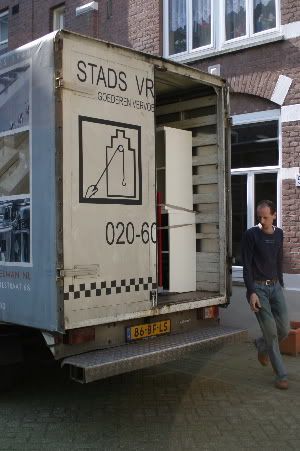
Many thanks to Ton & Bart from Stads Vracht Taxi. If you're going to move in Amsterdam, give them a call 020-606-0789 because they are careful and responsible and very reasonable in cost.
Many thanks to Ton & Bart from Stads Vracht Taxi. If you're going to move in Amsterdam, give them a call 020-606-0789 because they are careful and responsible and very reasonable in cost.
Blognomics 2005 Amsterdam

On April 21st I attended the Blognomics 2005 Symposium at the RAI Conference Center in Amsterdam. Put together by Guido van Nispen and his merry crew, this event shined a spotlight on the landscape of blogging in the Netherlands for us to see. You can access the speakers' presentations here.
What caught my attention was the growing influence of MSN's "Spaces" mini-blog product - expanding on the MSN Messenger platform where people can share more than just words. Within a few months of introduction, MSN Spaces had enlisted more than 500,000 people here in the Netherlands. When you consider that Ilse Media hosts almost 100,000 bloggers on its server of the approximate 250,000 blogs here, MSN Spaces is sweeping up the average person who just wants to share with his immediate community of friends and family. Their connectivity is at an intimate level and enabled with photo sharing.
The more serious bloggers - for both personal and business blogging - are using Ilse Media, Blogger, and MoveableType or Typepad from Six Part.
Another eye-opener for me was the number of serious business bloggers only blogging in the Dutch language. When I read through their blogs, I realized they were hubs for sharing what was happening in their own market and also filtering and adapting the English language trends and concepts into Dutch for distribution. Now I want to discover the Dutch bloggers who are translating the Dutch trends and concepts for global digestion. If you are, please send me your link!
Jonathan Marks and I interviewed some of the speakers and attendees on camera. We caught these speakers: Guido van Nispen our host, Paul Molenaar from Ilse Media, Loic Le Meur from Six Apart, Marco Derksen from his blog MarketingFacts, and Peter Olsthoorn the journalist who publishes Netkwesties. We wanted to capture their thoughts about the impact of blogging and how it's reshaping how we do business. Jonathan will compile these video interviews and post them once he returns from his trip to Mexico City for a conference on the future of broadcasting.
Check out the photos from Blognomics 2005.
Other blogging members of our working group The Dutch Connection were also there: Jonathan Marks, Ton Zijlstra, Elmine Wijnia, and James Burke.
Many of the links to Blognomics 2005 are in the Dutch language because this was a symposium in Dutch for local participants.
20 April 2005
The moving truck broke!
We waited for hours today for the movers to show up. They called and said they were delayed, which I thought was really considerate. Finally, around 4 pm, they just couldn't get their truck fixed or get another arranged in time.
This gave us a chance to put our Zen response into practice - "everything has a reason." We took a couple of very deep cleansing breaths, calmly commiserated with the movers, rescheduled for Saturday and sinply let go. This means sleeping at a friend's house for a couple of days because everything is packed and ready to move. At this point of exhaustion, we just said, "ah...perhaps some rest."
The movers called back and apologized again. Now, I am really impressed.
So, Saturday we move.
This gave us a chance to put our Zen response into practice - "everything has a reason." We took a couple of very deep cleansing breaths, calmly commiserated with the movers, rescheduled for Saturday and sinply let go. This means sleeping at a friend's house for a couple of days because everything is packed and ready to move. At this point of exhaustion, we just said, "ah...perhaps some rest."
The movers called back and apologized again. Now, I am really impressed.
So, Saturday we move.
19 April 2005
Moving this week
Renovating my new apartment has just eaten up my time the past few weeks, Tomorrow is moving day. Once this is behind me, I can focus on the outside world again.
Check back with me in a couple of days. We are involved in so many interesting projects, conferences and efforts right now that I will have lots to share about all of this.
Have a great week!
Check back with me in a couple of days. We are involved in so many interesting projects, conferences and efforts right now that I will have lots to share about all of this.
Have a great week!
9 April 2005
Double Dutch
There are so many sayings with the word "Dutch" in them. Trying to explain them to people who are actually from The Netherlands can be quite funny. When we were growing up, my sister and I played a lot of jump rope. One of the most difficult - but most fun - tricks was with a double strand of rope, where we had to turn each strand into the other and jump both ropes. It required serious rhythm. We called it double-dutch. Now there are competitions for it.
Here are some amazing videos of girls and guys doing double dutch.
Double Duchess

Double Duchess Cat Costumes
Double Dutch in Harlem
Here are some amazing videos of girls and guys doing double dutch.
Double Duchess
Double Duchess Cat Costumes
Double Dutch in Harlem
3 April 2005
Vores ØL - The World's 1st Open Source Beer
A group of students at the IT University in Copenhagen have created Vores ØL - Our Beer, in English - in collaboration with Superflex as an experiment in applying modern open source ideas to methods in traditional real-world product. Superflex plays with social interaction and creative practice to bring new thinking and ways into the mainstream.

You can find everything you want to know about the beer on their Vores ØL site.
This caught my attention because I have worked with beer clients for 30 years. Beer brands struggle with marketing, advertising and promotion because people are no longer susceptible to gimmicks that have traditionally pushed beer sales. People seek out authenticity today. They want to be more than just consumers. That means they are also exploring idealogical alignments.
I wonder how many other product and service brands will follow this. My instincts tell me this is only the beginning of the exploration into how brands can become part of mediated environments and join communities in co-creation of their extended life.
You can find everything you want to know about the beer on their Vores ØL site.
This caught my attention because I have worked with beer clients for 30 years. Beer brands struggle with marketing, advertising and promotion because people are no longer susceptible to gimmicks that have traditionally pushed beer sales. People seek out authenticity today. They want to be more than just consumers. That means they are also exploring idealogical alignments.
I wonder how many other product and service brands will follow this. My instincts tell me this is only the beginning of the exploration into how brands can become part of mediated environments and join communities in co-creation of their extended life.
2 April 2005
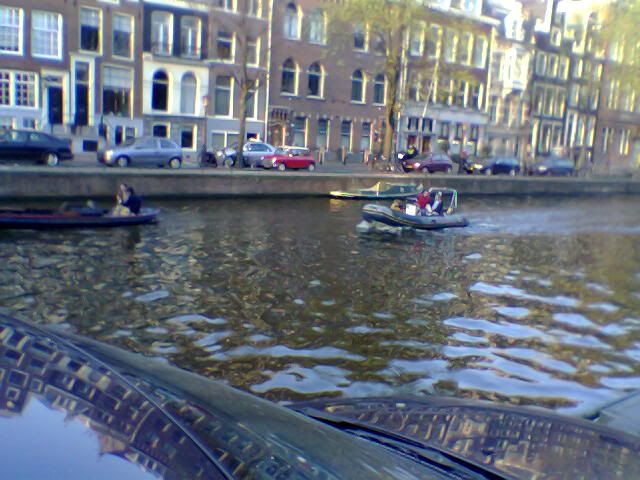
Beautiful on the Canals
I've been renovating my apartment all week, so I took a spin through the canals this afternoon. Amsterdam is so beautiful when the sun is shining.
28 March 2005
News - The 2005 Sumatran Earthquake
Another earthquake for Indonesia - The 2005 Sumatran earthquake occurred at 16:09:37 UTC (23:09:37 local time) on March 28, 2005. The epicenter was located at 2° 05' 35" N 97° 00' 58" and 30 km below the surface of the Indian Ocean, 200 km west of Sibolga, Sumatra, or 1400 km northwest of Jakarta.
You can follow the latest news as it is updated on Wikipedia.

You can follow the latest news as it is updated on Wikipedia.
22 March 2005
Clarifying our Roles between Citizen & Consumer
My answer to Margaret's challenge below is another challenge:
How can we clarify our roles between citizen and consumer?
For me, I can begin to see from all the conferences, discussions, issues - and also our human need to belong and give from ourselves - that we have to start making informed and responsible choices about world issues, and local ones as well, from our roles as citizens and not from our roles as consumers.
For too long, we have behaved out of our consumer role...and this has led us into the permanent struggle of consumer politics. Statesmenship and active citizenship have gotten hijacked along the way by consumerism. It was fun while it lasted, but we gave corporations way too much power over our real lives, which then found it's way into the political agenda as a norm.
So many of us - now enabled through social media and technology - have acted on our social cause and banded together to enable a transformation. Even some corporations and businesses are acting on this - CSR - corporate social responsibility.
I will drop a very interesting fact here: By 2015, India will have 60 million PhD scientists, which is more than the whole of the population of the the UK and 4 times the population of The Netherlands. How will that impact our country and global economics? How will that impact our social agenda? How will that impact our creative capital?
How can we clarify our role of citizen and learn to act from that value paradigm when we are faced with the responsibility regarding difficult issues that impact our education, our health, our commons and our human welfare? How can we use our consumer role to empower our role as citizen to build the necessary bridges and the critical mass needed to get people to cross them?
Can we be more creative with information and knowledge to find innovative solutions to larger issues if we change our roles?
Please share your thoughts on this. Does this touch anyone?

Image borrowed from Roy Christopher with credit due and many thanks
Margaret Gold posted a challenge today on the The Dutch Connection Forum:
What is the frontier of our generation?
I just read the most amazing idea, in an HBS Working Knowledge article about how a group of fresh grads decided to start-up a company in the space industry:
"At the Space Foundation awards ceremony earlier that day, Webster had heard featured speaker Ben Bova quote from James Michener's novel Space, and in that moment, he knew he had to work in the space industry. "The quote was about how each generation is presented with a frontier," he says now. "And if you didn't find a way to work on your generation's frontier, you would miss the meaning of your own epic, your own age. Our frontier was, and is, space, and I wanted to be there."
It really got me to thinking - what is the frontier of my generation? Is it bioscience? Biotech? It seems too easy and short-sighted to say the Internet.....
Margaret Gold
How can we clarify our roles between citizen and consumer?
For me, I can begin to see from all the conferences, discussions, issues - and also our human need to belong and give from ourselves - that we have to start making informed and responsible choices about world issues, and local ones as well, from our roles as citizens and not from our roles as consumers.
For too long, we have behaved out of our consumer role...and this has led us into the permanent struggle of consumer politics. Statesmenship and active citizenship have gotten hijacked along the way by consumerism. It was fun while it lasted, but we gave corporations way too much power over our real lives, which then found it's way into the political agenda as a norm.
So many of us - now enabled through social media and technology - have acted on our social cause and banded together to enable a transformation. Even some corporations and businesses are acting on this - CSR - corporate social responsibility.
I will drop a very interesting fact here: By 2015, India will have 60 million PhD scientists, which is more than the whole of the population of the the UK and 4 times the population of The Netherlands. How will that impact our country and global economics? How will that impact our social agenda? How will that impact our creative capital?
How can we clarify our role of citizen and learn to act from that value paradigm when we are faced with the responsibility regarding difficult issues that impact our education, our health, our commons and our human welfare? How can we use our consumer role to empower our role as citizen to build the necessary bridges and the critical mass needed to get people to cross them?
Can we be more creative with information and knowledge to find innovative solutions to larger issues if we change our roles?
Please share your thoughts on this. Does this touch anyone?
Image borrowed from Roy Christopher with credit due and many thanks
Margaret Gold posted a challenge today on the The Dutch Connection Forum:
What is the frontier of our generation?
I just read the most amazing idea, in an HBS Working Knowledge article about how a group of fresh grads decided to start-up a company in the space industry:
"At the Space Foundation awards ceremony earlier that day, Webster had heard featured speaker Ben Bova quote from James Michener's novel Space, and in that moment, he knew he had to work in the space industry. "The quote was about how each generation is presented with a frontier," he says now. "And if you didn't find a way to work on your generation's frontier, you would miss the meaning of your own epic, your own age. Our frontier was, and is, space, and I wanted to be there."
It really got me to thinking - what is the frontier of my generation? Is it bioscience? Biotech? It seems too easy and short-sighted to say the Internet.....
Margaret Gold
21 March 2005
Podcasting the Future
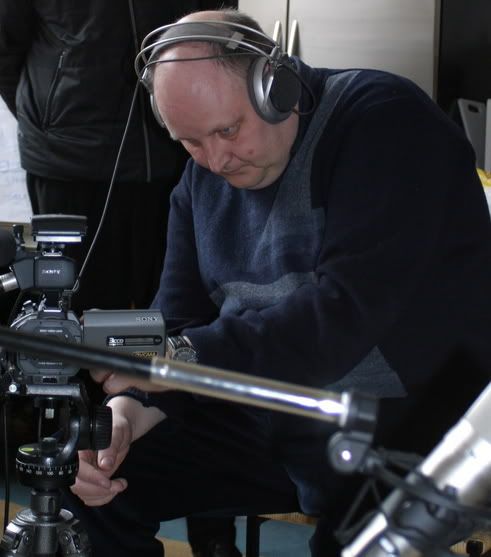
Jonathan Marks and I interviewed Joi Ito on Saturday for our new podcasting format. We also captutred his interview on film. Joi shared his views with us on where the world should be going. He was here in Amsterdam to speak at the Creative Captial Conference last week, which we also attended, and to meet with others about the Creative Commons.
We are accumulating podcasts in preparation for the premiere. Keep your eyes and ears open...this will be something completely unexpected.
20 March 2005
Global Rich List
If you would like to put your earnings into perspective, have a play with this interactive tool from Poke. See where you land on the Global Rich List of the world.

Poke is a creative group from London who wants "to inspire people through interactive media." Their rationale for putting this tool at our fingertips is to raise our awareness of how rich we are by world standards...and to possibly help us see how easy it is to share that wealth.
Poke is a creative group from London who wants "to inspire people through interactive media." Their rationale for putting this tool at our fingertips is to raise our awareness of how rich we are by world standards...and to possibly help us see how easy it is to share that wealth.
Report on the Creative Capital Conference - Amsterdam
I've just spent a few days with 300 people from 20 different countries discussing and debating "what society needs to enable people to be creative".
We heard from a range of well-informed speakers with relevant insights into new ways of organizing ourselves (Leadbeater); cities as artworks (Landry); remediating urban environments (Graham); the culture of creativity (Himanen); and remixing creativty and issues for the creative commons (Ito).
We attended break-out sessions with the same people to pursue a deeper conversation about these topics in the context of specific issues like Open Innovation, The Role of Artists and Creative Producers, Creative Cities, Climate for Creative Industries, Interaction between Creatives & Industry, Open Source as Innovation Model, Publicly Financed Content, Policy Challenges, and a New Agenda for Creative Cities.
My perspective of the conference has more to do with living here in the Netherlands than with the wealth of foreign talent and ideas that were present in the conference. We had a wonderful opportunity to take these ideas and explore how we could actually generate content to script an agenda for building creative capital. What happened was more prescriptive. It seemed like certain moderators had their own agenda already written and we were just assembled there to validate that. Other moderators were not aligned with their sessions speakers and didn't give the space to come to a common agreement on what we could contribute from our sessions.
What I truly appreciated about this conference was the networking between people sparked by the inspiration that somehow we might be able to come together and collaborate on a greater scale to bring this alive - here in Amsterdam or in the Netherlands.
Unfortunately, we have a special set of environmental factors that work against building creative capital here. First, the country's core value is security, which means Nederlanders and business here are risk aversive. Second, failure is severely punished, which means we have little or no entrepereneurial activities. Third, the national motto is "doe maar gewoon" - loosely translated that means "hold back, stifle yourself and don't try to be more than the next guy". Forth, it is a country that believes in transactions rather than relationships. Fifth, it is a country that puts everything in pigeonholes ("hokjes").
What does this mean for creativity here? We have to discover that. That is our new agenda. Innovation requires creativity, collaboration and an understanding of culture as context. Perhaps, with this as a starting point, we can begin the discussion that just might lead us through the crisis.
Let's pull off the security blanket and have a look at what's possible.
We heard from a range of well-informed speakers with relevant insights into new ways of organizing ourselves (Leadbeater); cities as artworks (Landry); remediating urban environments (Graham); the culture of creativity (Himanen); and remixing creativty and issues for the creative commons (Ito).
We attended break-out sessions with the same people to pursue a deeper conversation about these topics in the context of specific issues like Open Innovation, The Role of Artists and Creative Producers, Creative Cities, Climate for Creative Industries, Interaction between Creatives & Industry, Open Source as Innovation Model, Publicly Financed Content, Policy Challenges, and a New Agenda for Creative Cities.
My perspective of the conference has more to do with living here in the Netherlands than with the wealth of foreign talent and ideas that were present in the conference. We had a wonderful opportunity to take these ideas and explore how we could actually generate content to script an agenda for building creative capital. What happened was more prescriptive. It seemed like certain moderators had their own agenda already written and we were just assembled there to validate that. Other moderators were not aligned with their sessions speakers and didn't give the space to come to a common agreement on what we could contribute from our sessions.
What I truly appreciated about this conference was the networking between people sparked by the inspiration that somehow we might be able to come together and collaborate on a greater scale to bring this alive - here in Amsterdam or in the Netherlands.
Unfortunately, we have a special set of environmental factors that work against building creative capital here. First, the country's core value is security, which means Nederlanders and business here are risk aversive. Second, failure is severely punished, which means we have little or no entrepereneurial activities. Third, the national motto is "doe maar gewoon" - loosely translated that means "hold back, stifle yourself and don't try to be more than the next guy". Forth, it is a country that believes in transactions rather than relationships. Fifth, it is a country that puts everything in pigeonholes ("hokjes").
What does this mean for creativity here? We have to discover that. That is our new agenda. Innovation requires creativity, collaboration and an understanding of culture as context. Perhaps, with this as a starting point, we can begin the discussion that just might lead us through the crisis.
Let's pull off the security blanket and have a look at what's possible.
13 March 2005
EconoPhysics - Why it is hard to share the wealth
An article from New Scientist Breaking News - Why it is hard to share the wealth identifies a group of physicists who are building new models based on simple physical laws to understand wealth distribution.
"Economists will join physicists to discuss these issues next week in Kolkata, India, at the first ever conference on the "econophysics" of wealth distribution. "We are interested in understanding whether there is some kind of social injustice behind this skewed distribution," says Sudhakar Yarlagadda of the Saha Institute of Nuclear Physics (SINP) in Kolkata."
"While economists' models traditionally regard humans as rational beings who always make intelligent decisions, econophysicists argue that in large systems the behaviour of each individual is influenced by so many factors that the net result is random, so it makes sense to treat people like atoms in a gas."
The article discusses a few models and the roles they could play informing policy.
Saving seems to be the key to accumulating wealth.
"Economists will join physicists to discuss these issues next week in Kolkata, India, at the first ever conference on the "econophysics" of wealth distribution. "We are interested in understanding whether there is some kind of social injustice behind this skewed distribution," says Sudhakar Yarlagadda of the Saha Institute of Nuclear Physics (SINP) in Kolkata."
"While economists' models traditionally regard humans as rational beings who always make intelligent decisions, econophysicists argue that in large systems the behaviour of each individual is influenced by so many factors that the net result is random, so it makes sense to treat people like atoms in a gas."
The article discusses a few models and the roles they could play informing policy.
Saving seems to be the key to accumulating wealth.
11 March 2005
The Madrid Agenda - International Summit on Democracy, Terrorism and Security
The Madrid Agenda - International Summit on Democracy, Terrorism and Security honors the victims of the terrorist attack there one year ago today, 11 March 2005. The Club of Madrid - former presidents and prime ministers - collected leaders, experts and concerned citizens from around the world to discuss and establish guiding principles regarding terrorism, democracy and peace.

They call for adoption of The Madrid Recommendations and international cooperation in the fight against terrorism. They want to create an inter-linking of resources and a trust fund for those who cannot afford the resources to fight terrorism.
They identified intimidation, fear and hatred as the risk factors underlying terrorism. They want to promote dialogue through round tables about cultural differences. They ask the media to review their use of language. They propose to create programs to monitor racism, extremism and to promote cultural and religious tolerance.
They call for building democracy through reinforcing a civil society.
You can find The Infrastructure of Democracy: Strengthening the Open Internet for a Safer World - March 11, 2005 on the Global Voices wiki.
This is worth reading and serious reflection.
They call for adoption of The Madrid Recommendations and international cooperation in the fight against terrorism. They want to create an inter-linking of resources and a trust fund for those who cannot afford the resources to fight terrorism.
They identified intimidation, fear and hatred as the risk factors underlying terrorism. They want to promote dialogue through round tables about cultural differences. They ask the media to review their use of language. They propose to create programs to monitor racism, extremism and to promote cultural and religious tolerance.
They call for building democracy through reinforcing a civil society.
You can find The Infrastructure of Democracy: Strengthening the Open Internet for a Safer World - March 11, 2005 on the Global Voices wiki.
This is worth reading and serious reflection.
6 March 2005
Chris Allen's Presentation on Social Software & Social Networking
Many thanks to Dave Teten from the Brain Food Blog. He posted a link to a rather comprehensive presentation that Christopher Allen delivered as keynote speaker to the FVHA about Social Software & Social Networking. In his presentation, Chris lays out the landscape, tools and explains the journey. It's in .pdf format, so you can download it.
Last July, in his Life with Alacrity blog, Chris turned me on to the world of Dunbar's magical number of 150. He was exploring network ecosystems and effective group participation. That prompted me to write a blog about The Science of Dunbar's Number.
In this presentation, Chris once again raises the specter of just how many relationships can we truly manage as we reach out and touch hundreds through social business network platforms (SBNs) like Ecademy and LinkedIn?
Again, many thanks to both Dave Tetan and Chris Allen for sharing this.
Last July, in his Life with Alacrity blog, Chris turned me on to the world of Dunbar's magical number of 150. He was exploring network ecosystems and effective group participation. That prompted me to write a blog about The Science of Dunbar's Number.
In this presentation, Chris once again raises the specter of just how many relationships can we truly manage as we reach out and touch hundreds through social business network platforms (SBNs) like Ecademy and LinkedIn?
Again, many thanks to both Dave Tetan and Chris Allen for sharing this.
Wists
Wists is a visual bookmarking platform that lets you tag each site with an image or screenshot. You can link up with others by clicking on images they have tagged.

Think about this. Hey, we like the same images. What are you surfing and bookmarking? Folksonomies just took a learning curve into the visual identity forrest. Now, are you going to populate your bookmarks with images? Words? Both? The old saying is a picture's worth a 1000 words.
Of course, del.icio.us remains key for tracking with word tags. Both have the opportunity to pave a pathway toward new communities of interest.
But...I wonder if there are copyright issues here. Perhaps, this is where Creative Commons really comes into play.
Let me know how you play with Wist. I'm going to explore it as well...sniff, sniff...wonder when they'll have smells we can associate with the concepts we find attractive or useful.
Thanks to David Weinberger who posted Wist on the Many2Many group weblog on social software.
Think about this. Hey, we like the same images. What are you surfing and bookmarking? Folksonomies just took a learning curve into the visual identity forrest. Now, are you going to populate your bookmarks with images? Words? Both? The old saying is a picture's worth a 1000 words.
Of course, del.icio.us remains key for tracking with word tags. Both have the opportunity to pave a pathway toward new communities of interest.
But...I wonder if there are copyright issues here. Perhaps, this is where Creative Commons really comes into play.
Let me know how you play with Wist. I'm going to explore it as well...sniff, sniff...wonder when they'll have smells we can associate with the concepts we find attractive or useful.
Thanks to David Weinberger who posted Wist on the Many2Many group weblog on social software.
5 March 2005
Why vision is important
Yesterday, the class that I teach at The University of Amsterdam Graduate School of Business finally landed the vision for the alumni brand that they are developing.

I am teaching them how to use Applied Connective Dynamics to construct a dynamic network system incorporating the social, material and conceptual frameworks of human organizational systems. Basically, they learn about brands, identity and concepts and the business models that can support that organizationally.
Why is vision so important? We are moving from a product driven business model to a model of mobilizing communities. Communities are people. People need vision on their life, their beliefs, their way of coming together in practice.
Having a vision about where you take people is beacon for developing the guiding key strategies that will define the path forward for all involved in the brand. But, how do they know whether their vision is right?
I asked them to define the theory behind the practice of the brand. What is the ideology that will lead to results? If they can define this out of what they believe they can create for others, they will have the philosophy for their brand manifesto.
As far as I can see, they are on the right track. If you would like to follow their journey, let me know.
I am teaching them how to use Applied Connective Dynamics to construct a dynamic network system incorporating the social, material and conceptual frameworks of human organizational systems. Basically, they learn about brands, identity and concepts and the business models that can support that organizationally.
Why is vision so important? We are moving from a product driven business model to a model of mobilizing communities. Communities are people. People need vision on their life, their beliefs, their way of coming together in practice.
Having a vision about where you take people is beacon for developing the guiding key strategies that will define the path forward for all involved in the brand. But, how do they know whether their vision is right?
I asked them to define the theory behind the practice of the brand. What is the ideology that will lead to results? If they can define this out of what they believe they can create for others, they will have the philosophy for their brand manifesto.
As far as I can see, they are on the right track. If you would like to follow their journey, let me know.
Snowed again in Amsterdam
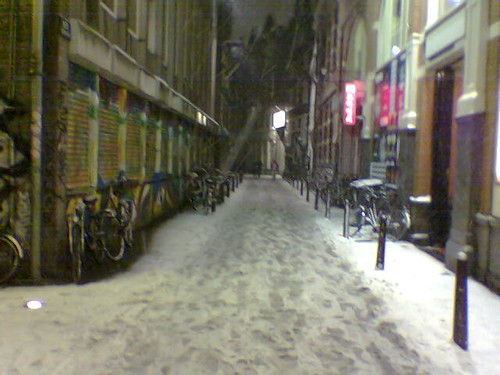
Last night I used the camera in my Nokia 6230 to capture the street in the snowstorm as I left the Harkema Restaurant in Amsterdam. The atmosphere had this feeling that we were transported back in time.
We're just not used to snow here. It's like a new toy for us.
4 March 2005
Yahoo! Netrospective: 10 years, 100 moments of the Web
Inspired by 10x10 by Jonathan J. Harris.
Yahoo celebrates 10 years. Remember the Yahoo portal back in 1995?

Yahoo celebrates 10 years. Remember the Yahoo portal back in 1995?
How Things Are Made
On this site from Stanford University, you can click "How everyday Things Are Made". Expect an entertaining surprise, fitted with snazzy Flash.
The Alliance for Innovative Manufacturing at Standford University has designed an online video show about how products are made and processes occur. I chose Jelly Beans for a start and moved straight into motorcycles. I closed it out with waterjet/laser cutting.
Companies could use this innovative piece of media tech for desktop training, and educators could distribute courses, narrated and documented.
We could put our course on Blogging & Wiki-ing for Idiots into this and sell it like petrol for mass mobilization in the new economy.
The Alliance for Innovative Manufacturing at Standford University has designed an online video show about how products are made and processes occur. I chose Jelly Beans for a start and moved straight into motorcycles. I closed it out with waterjet/laser cutting.
Companies could use this innovative piece of media tech for desktop training, and educators could distribute courses, narrated and documented.
We could put our course on Blogging & Wiki-ing for Idiots into this and sell it like petrol for mass mobilization in the new economy.
3 March 2005
Where do you keep your art?

I've just had the most engaging conversation with an 8 year old friend of mine. She asked me, "Where do you keep your art?"
Of course, I started to explain that the large paintings get boxed and stored in the studio before they get shipped. She interrupted me and asked me again, "I mean, where do you keep your art? In your body." She stared at me, expecting me to know the answer.
This would require some thinking, I thought. She immediately pointed to my heart and asked me again, "Where do you keep your art? In there?"
I took a deep breath and said, "My art is in a place I cannot reach, but I can always touch it with my mind if I go deep enough inside." She looked at me very seriously and asked, "Can you take me there once with you? I would like to go there and see what it's like. I don't think I've ever been there."
I am going to invite this wonderful little person to a day of brushes and paints and exploration.
Where do you keep your art?
Could Social Networking Save the World
Dave Pollard's blog - How to Save the World - is one of my favorite reads every day. He manages to consistently touch on topics dear to my heart and my head, and express wisdom that moves us further down our paths. He has once again caught the spirit of what is happening in our worlds.
He refers to Rob Patterson's paper about how social networking could save the world. Rob likens the impact of social software tools to how the printing press transformed life.
People now have the tools, software and platforms through Social Media to find like-minded souls and build communities online and face to face. This is transforming society, academia, business, economics, politics and will eventually reach politics. Personal social cause is at the heart of it. The power of sharing ideas with a sense of urgency is driving new ways of collaboration.
Read Dave's blog on this. You'll be inspired and will learn something enlightening about our human nature. He also has an amazing photo of networked colors of purple and green on black, which demonstrates networks, hubs and connections.
He refers to Rob Patterson's paper about how social networking could save the world. Rob likens the impact of social software tools to how the printing press transformed life.
People now have the tools, software and platforms through Social Media to find like-minded souls and build communities online and face to face. This is transforming society, academia, business, economics, politics and will eventually reach politics. Personal social cause is at the heart of it. The power of sharing ideas with a sense of urgency is driving new ways of collaboration.
Read Dave's blog on this. You'll be inspired and will learn something enlightening about our human nature. He also has an amazing photo of networked colors of purple and green on black, which demonstrates networks, hubs and connections.
2 March 2005
Amsterdam Snowstorm
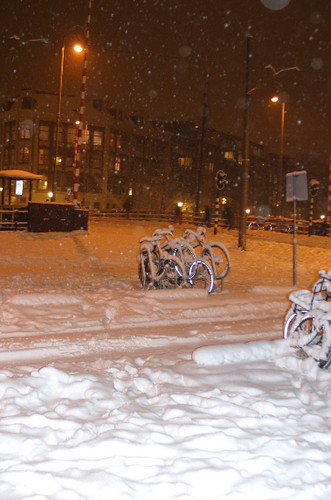
This is the biggest snowstorm in Amsterdam in 50 years. No cars, no bikes, no trams...it's so quiet.
And...it's still snowing.
7 Habits of Highly Effective Blog PR
In less than a year, blogging has become one of the essential channels in the journalistic mix for a PR campaign. Blogs have impact and repercussions beyond TV and print because they connect people together in cause.
Last week, Nick Wreden from FusionBrand captured the essence of experienced PR experts in blogging - FusionBrand: 7 Habits of Highly Effective Blog PR.
1. Never pitch, personalize
2. Respect a blogger's time and intelligence
3. "A blog is not about you, it is about me"
4. Quality, not quantity
5. Feed the food chain
6. It's no longer just about the media
7. Keep learning
Last week, Nick Wreden from FusionBrand captured the essence of experienced PR experts in blogging - FusionBrand: 7 Habits of Highly Effective Blog PR.
1. Never pitch, personalize
2. Respect a blogger's time and intelligence
3. "A blog is not about you, it is about me"
4. Quality, not quantity
5. Feed the food chain
6. It's no longer just about the media
7. Keep learning
Subscribe to:
Posts (Atom)